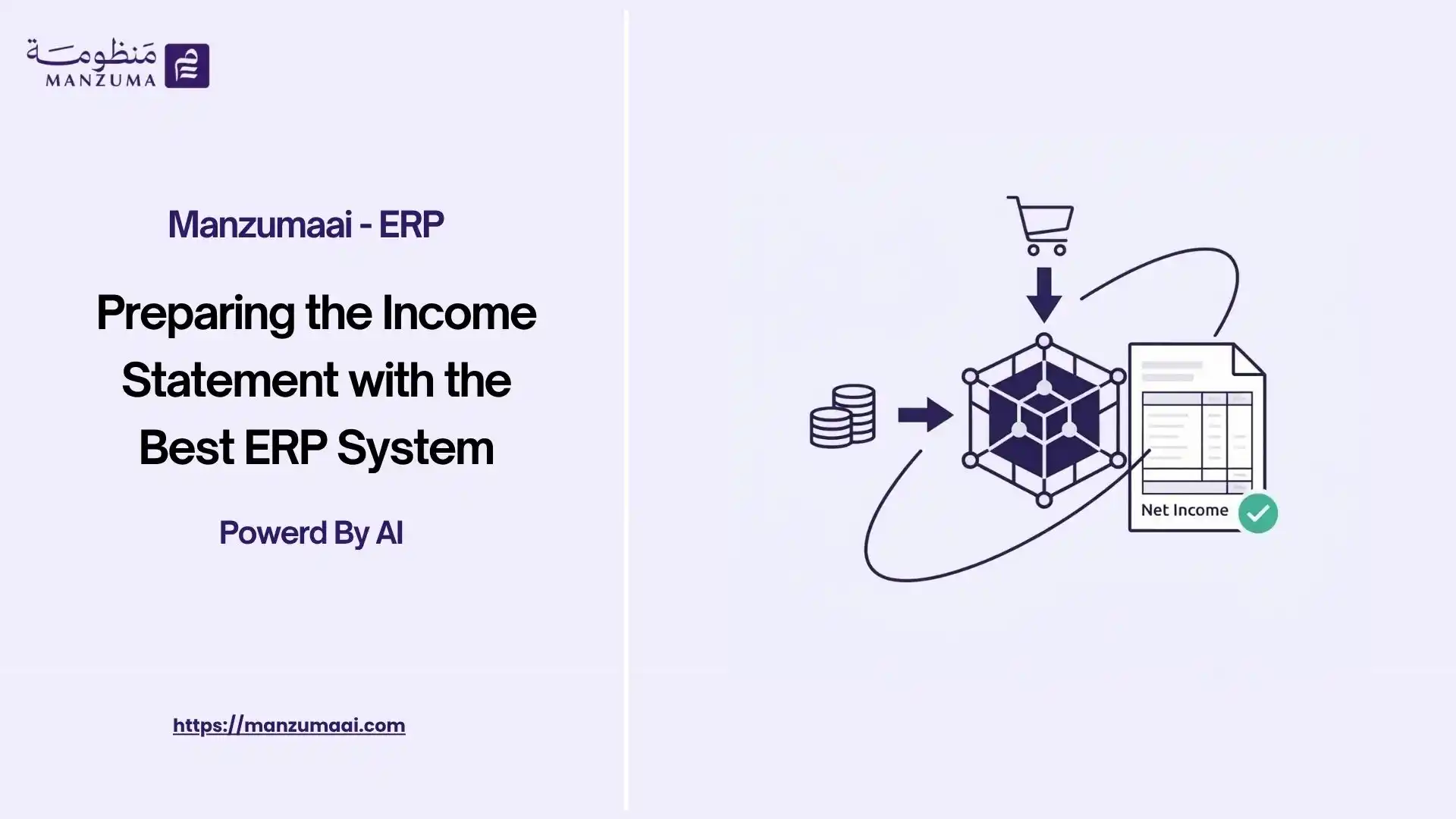
- What Is Preparing the Income Statement and Statement of Financial Position?
- What Is an Income Statement?
- What Is the Statement of Financial Position?
- What's the Difference Between the Income Statement and the Statement of Financial Position?
- Why Is Preparing the Income Statement and Statement of Financial Position Critical for Financial Decision-Making?
- What Data Is Required for Preparing the Income Statement and Statement of Financial Position?
- Common Mistakes That Affect Preparing the Income Statement and Statement of Financial Position
- How Does an ERP System Simplify Preparing the Income Statement and Statement of Financial Position?
- How Does ERP Accelerate Financial Reporting?
- Accuracy
- How Does Manzuma AI Help with Preparing the Income Statement and Statement of Financial Position?
- What Should You Look for When Choosing an ERP System for Financial Reporting?
- Why Is Manzuma AI the Best ERP Solution for Preparing the Income Statement and Statement of Financial Position?
- FAQs
- What does preparing the income statement and statement of financial position involve?
- Why is preparing the income statement important for businesses?
- How does an ERP system improve financial statement preparation?
- What are the main benefits of preparing financial statements with an ERP system?
- Why is Manzuma AI a strong choice for financial reporting?
Preparing the income statement and the statement of financial position is one of the most important financial reporting processes for any organization Together these reports provide a comprehensive view of a company's profitability financial health and overall business performance enabling executives to make informed strategic decisions based on reliable financial data
Whether you're a growing business or a large enterprise implementing an ERP solution streamlines financial reporting improves data accuracy and provides the visibility needed to support long-term growth
What Is Preparing the Income Statement and Statement of Financial Position?
Preparing the income statement and statement of financial position is the process of organizing and presenting a company's financial information in standardized reports that accurately reflect its financial performance and position
Although these statements are closely related each serves a distinct purpose in financial reporting Together they provide management investors auditors and stakeholders with the insights required to evaluate business performance and financial stability
What Is an Income Statement?
The income statement also known as the profit and loss statement (P&L) summarizes a company's financial performance over a specific accounting period
It measures how effectively the business generates revenue while controlling expenses and ultimately determines whether the company has earned a profit or incurred a loss
A standard income statement typically includes:
- Operating revenue
- Cost of goods sold (COGS)
- Gross profit
- Operating expenses
- Administrative and selling expenses
- Other income and expenses
- Taxes
- Net profit or net loss
By analyzing these figures business leaders can identify profitability trends evaluate operational efficiency and make data-driven decisions to improve financial performance
What Is the Statement of Financial Position?
The statement of financial position commonly referred to as the balance sheet provides a snapshot of a company's financial condition at a specific point in time
Rather than measuring performance over a period it shows what the business owns what it owes and the value remaining for shareholders
The statement of financial position generally consists of three major sections
- Assets
- Current assets
- Non-current (fixed) assets
- Liabilities
- Current liabilities
- Long-term liabilities
- Shareholders' Equity
- Paid-in capital
- Retained earnings
- Other equity balances
This statement helps organizations evaluate liquidity financial stability capital structure and their ability to meet both short-term and long-term obligations
What's the Difference Between the Income Statement and the Statement of Financial Position?
Although both reports are essential financial statements they answer different business questions
- Income Statement
- Statement of Financial Position
- Measures financial performance over a reporting period
- Shows financial position at a specific date
- Focuses on revenue expenses and profitability
- Focuses on assets liabilities and equity
- Explains how profit or loss was generated
- Explains what the company owns and owes
- Supports profitability analysis
- Supports financial health and solvency analysis
Together these statements provide a complete picture of an organization's financial performance and long-term sustainability
Why Is Preparing the Income Statement and Statement of Financial Position Critical for Financial Decision-Making?
Preparing accurate financial statements is far more than a regulatory requirement It is the foundation of effective financial management and strategic planning
Reliable financial reports enable executives to monitor business performance assess profitability manage risks and make confident investment decisions They also provide transparency for shareholders lenders auditors and regulatory authorities
Organizations that produce accurate and timely financial statements are better positioned to respond to market changes and identify new growth opportunities
Key business benefits include:
- Measuring overall financial performance with confidence
- Monitoring profitability and operational efficiency
- Supporting budgeting and financial forecasting
- Improving cash flow planning and working capital management
- Evaluating investment and expansion opportunities
- Ensuring compliance with local and international accounting standards
- Increasing transparency for investors auditors and stakeholders
- Enabling faster executive decision-making through real-time financial insights
With a modern ERP platform these benefits become even more significant because financial data is updated automatically as business transactions occur allowing organizations to generate accurate reports whenever they are needed
What Data Is Required for Preparing the Income Statement and Statement of Financial Position?
The accuracy of preparing the income statement and the statement of financial position depends entirely on the quality and completeness of financial data Even minor errors in transaction recording can affect profitability calculations financial ratios compliance reporting and executive decision-making
Traditional accounting methods often require finance teams to gather information manually from multiple departments An ERP system eliminates this challenge by integrating accounting sales purchasing inventory fixed assets payroll and banking into a single centralized platform ensuring that financial statements are generated from consistent real-time data
Data Required for the Income Statement
To produce an accurate income statement organizations typically need the following information
- Operating revenue
- Non-operating income
- Cost of goods sold (COGS)
- Selling and administrative expenses
- Operating expenses
- Depreciation and amortization
- Interest income and expenses
- Taxes
- Net profit or net loss
These figures allow finance teams to evaluate profitability operating efficiency and overall business performance during a specific accounting period
Data Required for the Statement of Financial Position
The statement of financial position requires a complete overview of the company's financial resources and obligations including
Current assets
- Fixed and long-term assets
- Cash and bank balances
- Accounts receivable
- Inventory
- Accounts payable
- Short-term liabilities
- Long-term liabilities
- Shareholders' equity
- Retained earnings
When this information is automatically synchronized across every department businesses can generate financial statements with greater accuracy and significantly less manual effort
Common Mistakes That Affect Preparing the Income Statement and Statement of Financial Position
Financial reporting is only as reliable as the underlying accounting records Inaccurate or incomplete data can result in misleading reports poor business decisions compliance issues and unnecessary audit findings
Some of the most common accounting mistakes include:
- Recording journal entries incorrectly
- Failing to reconcile accounts before financial reporting
- Delayed posting of financial transactions
- Duplicate transaction entries
- Missing revenue or expense records
- Incorrect depreciation calculations
- Errors in tax calculations
- Manual data entry mistakes
- Using disconnected accounting systems
- Relying on outdated financial information
Modern ERP software minimizes these risks by automating accounting workflows validating transactions and maintaining a single source of truth across the organization
How Does an ERP System Simplify Preparing the Income Statement and Statement of Financial Position?
An ERP system transforms financial reporting by connecting every financial process within a unified platform Instead of collecting data manually from different systems finance teams can generate accurate financial statements automatically using real-time transactional data
This level of automation not only saves time but also improves reporting accuracy strengthens compliance and enhances visibility across the business
Key ERP capabilities include:
- Automatic journal entry creation
- Real-time financial data synchronization
- Integrated accounting across all departments
- Automated depreciation calculations
- Automated tax calculations
- Continuous account reconciliation
- Standardized financial reporting
- Built-in compliance with accounting standards
- Reduced manual data entry
- Improved financial accuracy
Because all financial activities are connected within a centralized ERP environment companies can prepare the income statement and statement of financial position in minutes rather than days
How Does ERP Accelerate Financial Reporting?
Speed is essential in modern financial management Executives need immediate access to reliable financial information to respond quickly to market changes monitor performance and make strategic decisions
Unlike traditional accounting systems that require extensive manual preparation at month-end ERP platforms continuously update financial records as transactions occur
As a result businesses can generate accurate financial reports on demand without waiting for lengthy closing procedures
- ERP accelerates financial reporting by enabling
- One-click financial statement generation
- Automatic updates after every financial transaction
- Real-time financial dashboards
- Live KPI monitoring
- Faster month-end and year-end closing
- Easy report sharing with executives and auditors
- Multiple export formats for reporting and compliance
- Instant access to company-wide financial data
With real-time reporting capabilities finance leaders an identify trends monitor cash flow evaluate profitability and support executive decision-making with greater speed and confidence
Manual Financial Statements vs ERP-Based Financial Reporting
Many organizations still rely on spreadsheets and manual accounting processes to prepare financial statements While this approach may be manageable for small businesses it becomes increasingly inefficient as transaction volumes grow and financial operations become more complex
An ERP system replaces fragmented manual workflows with an integrated financial platform that automates reporting improves data accuracy and provides real-time visibility into business performance
Time and Efficiency
Manual Process
- Requires collecting data from multiple systems
- Financial reports often take days or weeks to prepare
- Month-end closing is slow and labor-intensive
ERP System
- Consolidates financial data automatically
- Generates reports within minutes
- Significantly accelerates month-end and year-end closing
Accuracy
Manual Process
- High risk of human error
- Duplicate entries and inconsistent records are common
- Reconciliation requires significant manual effort
ERP System
- Uses a centralized database as a single source of truth
- Automates calculations and validations
- Reduces accounting errors and improves financial consistency
Cost and Productivity
Manual Process
- Requires more administrative effort
- Higher operational costs as the business grows
- Finance teams spend valuable time on repetitive tasks
ERP System
- Lowers operational costs through automation
- Improves employee productivity
- Allows finance professionals to focus on analysis and strategic planning rather than manual data processing
For organizations seeking faster reporting greater accuracy and scalable financial operations ERP has become the preferred solution
How Does Manzuma AI Help with Preparing the Income Statement and Statement of Financial Position?
Manzuma AI provides an integrated ERP system that helps businesses prepare the income statement and balance sheet accurately and automatically by connecting financial operations within a single platform.
The system enables businesses to:
- Automatically record financial transactions: The system automatically records financial transactions generated by sales, purchases, expenses, collections, and payments, reducing manual data entry and minimizing accounting errors.
- Prepare the income statement and balance sheet: The system automatically prepares the income statement and balance sheet based on up-to-date financial data, eliminating the need to manually collect information from multiple sources.
-
Connect accounting with business operations: The system connects accounting with:
- Sales management
- Purchasing management
- Inventory and warehouse management
- Fixed asset management
This integration ensures seamless data flow between departments and keeps financial records consistently updated.
- Create real-time financial dashboards: The system provides real-time financial dashboards that display revenue, expenses, profitability, cash flow, and key financial performance indicators in one place.
- Generate analytical financial reports: The system generates analytical financial reports covering revenue, expenses, profitability, and overall financial performance, helping management evaluate results and identify areas for improvement.
- Support financial decision-making: By relying on continuously updated financial data, the system helps management make faster and more accurate financial decisions based on the company’s actual financial position.
With this level of integration, businesses can improve operational efficiency, reduce errors, and accelerate the financial closing process.
ERP systems are not limited to a specific type of business. They can support companies across different industries by connecting financial management with their day-to-day operations and providing accurate, up-to-date data for preparing financial statements.
ERP for the Trading Industry
An ERP system helps trading companies connect sales, purchasing, inventory, and accounting, making it easier to track revenue, cost of sales, expenses, and profitability while preparing financial statements using up-to-date data.
ERP for the Manufacturing Industry
ERP systems support manufacturing companies by connecting production, purchasing, inventory, costing, and accounting processes, helping businesses calculate production costs, analyze profitability, and prepare accurate financial reports and statements.
ERP for the Construction Industry
An ERP system helps construction companies connect projects with expenses, purchases, resources, and accounting, allowing them to track the cost, revenue, and profitability of each project and understand its impact on overall financial performance.
ERP for the Services Industry
ERP systems help service-based businesses manage revenue, expenses, invoices, and payments while connecting them with accounting processes, providing integrated financial data for preparing financial statements and reports.
ERP for the Healthcare Industry
An ERP system helps healthcare organizations connect financial operations with purchasing, inventory, expenses, and revenue, providing greater visibility into financial performance and simplifying the preparation of financial reports and statements.
ERP for the Hospitality Industry
ERP systems connect revenue, expenses, purchasing, inventory, and operational activities across hospitality businesses, helping hotels and other hospitality organizations monitor profitability and generate accurate financial reports.
ERP for the Travel and Tourism Industry
An ERP system helps travel and tourism companies manage sales, bookings, payments, and expenses while connecting these operations with accounting, providing updated financial data for monitoring performance and preparing financial statements.
ERP for the Distribution Industry
ERP systems support distribution companies by integrating sales, purchasing, inventory, warehouse management, and accounting, helping businesses monitor product costs, revenue, and profit margins while improving the accuracy of financial reporting.
What Should You Look for When Choosing an ERP System for Financial Reporting?
Selecting the right ERP solution is a long-term investment that directly impacts financial efficiency reporting accuracy and business growth Beyond core accounting functionality organizations should evaluate how well the platform supports automation compliance and future scalability
When evaluating an ERP system consider the following factors:
- User-friendly interface with minimal training requirements
- Comprehensive accounting and financial management capabilities
- Seamless integration with sales purchasing inventory payroll and fixed assets
- Automated financial statement generation
- Real-time financial reporting and dashboards
- Compliance with local and international accounting standards
- Advanced security and role-based access controls
- Flexible reporting and business intelligence tools
- Scalability to support future business growth
- Reliable technical support and regular software updates
Choosing an ERP platform with these capabilities enables organizations to streamline financial reporting improve operational efficiency and maintain greater confidence in their financial data
Why Is Manzuma AI the Best ERP Solution for Preparing the Income Statement and Statement of Financial Position?
Manzuma AI combines intelligent automation advanced financial management and enterprise-wide integration to simplify preparing the income statement and the statement of financial position Designed for modern businesses the platform eliminates manual financial reporting processes while delivering accurate real-time insights that support better decision-making
Unlike traditional accounting software Manzuma AI connects every financial transaction across the organization—from sales and purchasing to inventory fixed assets payroll and banking—creating a single reliable source of financial data
Key Benefits of Manzuma AI:
Organizations using Manzuma AI can benefit from:
- Automated preparation of income statements and statements of financial position
- Automatic journal entry creation and financial transaction processing
- Real-time financial reporting with continuously updated data
- Interactive dashboards for monitoring financial KPIs
- Seamless integration across finance and operational departments
- Advanced financial analytics to support strategic planning
- Automated month-end and year-end closing processes
- Compliance with local and international accounting standards
- Secure centralized financial data management
- Scalable ERP capabilities that grow with your business
By automating routine accounting tasks and providing instant access to reliable financial information Manzuma AI enables finance teams to work more efficiently while giving executives the insights they need to drive sustainable business growth
Preparing the income statement and the statement of financial position is no longer just an accounting requirement—it is a strategic process that empowers organizations to evaluate financial performance maintain compliance and make informed business decisions
As companies expand manual financial reporting becomes increasingly time-consuming and prone to errors A modern ERP solution addresses these challenges by automating accounting workflows centralizing financial data and delivering accurate reports in real time
FAQs
What does preparing the income statement and statement of financial position involve?
It involves collecting organizing and reporting financial data to produce two essential financial statements The income statement measures a company's profitability over a reporting period while the statement of financial position presents its assets liabilities and equity at a specific point in time
Why is preparing the income statement important for businesses?
Preparing the income statement allows organizations to evaluate profitability monitor operating performance control expenses and support strategic financial planning It also provides investors auditors and stakeholders with a clear view of business performance
How does an ERP system improve financial statement preparation?
An ERP system automates financial data collection journal entries reconciliations tax calculations and reporting By integrating information across departments it enables businesses to generate accurate financial statements quickly while reducing manual errors
What are the main benefits of preparing financial statements with an ERP system?
Key advantages include:
- Faster financial reporting
- Improved accuracy through automation
- Real-time financial insights
- Better regulatory compliance
- Reduced manual workload
- More informed decision-making
- Accelerated month-end and year-end closing
Why is Manzuma AI a strong choice for financial reporting?
Manzuma AI offers a fully integrated ERP platform that automates financial processes centralizes business data and generates accurate financial statements in real time Its advanced analytics intelligent dashboards and enterprise-wide integration help organizations improve efficiency strengthen financial control and make data-driven decisions with confidenc
Ready to Organize Your Business?
Try Manzuma free for 14 days — no credit card, no commitment.