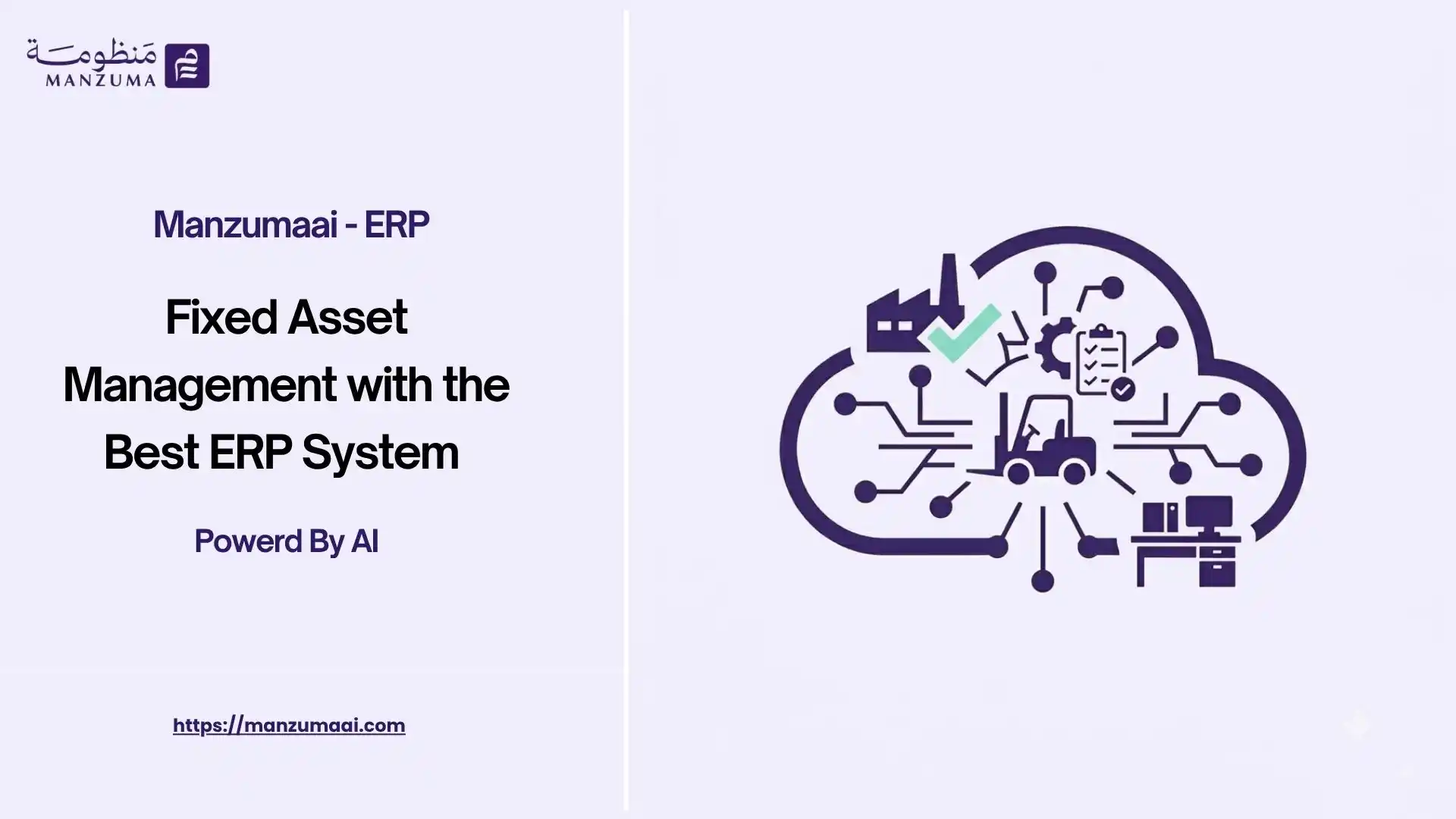
- What Is Fixed Asset Management in an ERP System?
- What Are the Types of Fixed Assets?
- Why Do Businesses Need an ERP System for Fixed Asset Management?
- Key Benefits of ERP-Based Fixed Asset Management
- How Does an ERP System Manage the Entire Fixed Asset Lifecycle?
- How Does an ERP System Automate Asset Depreciation?
- How Does Fixed Asset Management Improve Financial Decision-Making?
- What Is the Difference Between Traditional Fixed Asset Management and an ERP System?
- How Does Fixed Asset Management Integrate with Other ERP Modules?
- Which Industries Use ERP Systems for Fixed Asset Management?
- What Reports Does an ERP System Provide for Fixed Asset Management?
- How Is AI Transforming Fixed Asset Management?
- How to Choose the Best ERP System for Fixed Asset Management
- Why Choose Manzuma AI for Fixed Asset Management?
- FAQs
- What is fixed asset management?
- Does an ERP system automate asset depreciation?
- What are the main benefits of ERP-based fixed asset management?
- Can fixed asset management integrate with accounting and procurement?
- Why is Manzuma AI a strong choice for fixed asset management?
Fixed asset management has become a critical business function for organizations that rely on physical assets to support daily operations and long-term growth As companies expand managing equipment buildings vehicles machinery and technology assets manually becomes increasingly inefficient leading to inaccurate records compliance risks and unnecessary operational costs
Manzuma AI ERP delivers an intelligent approach to fixed asset management by combining automation AI-powered insights and seamless integration with finance procurement maintenance and inventory management This enables organizations to maximize asset value improve financial accuracy and accelerate digital transformatio
What Is Fixed Asset Management in an ERP System?
Fixed asset management refers to the process of recording monitoring maintaining depreciating and retiring long-term business assets throughout their entire lifecycle These assets typically include:
- Buildings and facilities
- Manufacturing equipment
- Machinery
- Company vehicles
- Office equipment
- Computers and IT infrastructure
- Production tools
Within an ERP system every asset is managed from a centralized database The platform records acquisition details calculates depreciation automatically tracks maintenance activities monitors asset locations and updates financial records whenever an asset is transferred sold or disposed of
This unified approach improves financial reporting strengthens internal controls and helps organizations maintain compliance with accounting standards such as IFRS and GAAP
What Are the Types of Fixed Assets?
Fixed assets include the various properties, equipment, and other long-term resources a company owns and uses in its day-to-day operations. They are generally held for long-term use rather than for resale. The types of fixed assets a company has depend on the nature of its business, with the most common examples including:
- Land: Land owned by the company and used for business purposes.
- Buildings and Facilities: Such as offices, factories, warehouses, and branches.
- Machinery and Equipment: Including production lines, machinery, and operational equipment.
- Vehicles: Such as company cars, trucks, and other vehicles used in business operations.
- Furniture and Fixtures: Including desks, chairs, cabinets, and other interior fixtures.
- Technology and IT Equipment: Such as computers, servers, printers, and networking equipment.
- Assets Under Construction: Assets that are still being built or prepared and are not yet ready for use.
- Leasehold Improvements: Modifications and improvements made to leased properties to support long-term business use.
When classifying fixed assets, companies should consider how each asset is used, their applicable accounting policies, and the relevant accounting standards.
Why Do Businesses Need an ERP System for Fixed Asset Management?
As organizations grow manually managing hundreds or thousands of assets becomes increasingly difficult Disconnected spreadsheets outdated records and manual depreciation calculations often result in reporting errors compliance issues and inefficient asset utilization
A modern ERP solution eliminates these challenges by providing complete visibility into every business asset
Key benefits include:
- Centralized asset records across the organization
- Reduced manual errors through automation
- Real-time asset tracking
- Automated depreciation calculations
- Faster auditing and inventory verification
- Better maintenance planning
Key Benefits of ERP-Based Fixed Asset Management
An ERP platform offers far more than simple asset tracking It creates a comprehensive management environment that improves operational efficiency and financial transparency
Some of the most valuable capabilities include:
Centralized Asset Records
Maintain complete information for every asset—including acquisition date purchase cost warranty location assigned employee useful life and current status—in a single database
Real-Time Asset Tracking
Monitor asset locations movements utilization and operational status across departments branches and multiple business locations
Automated Depreciation Management
Automatically calculate depreciation using multiple accounting methods while ensuring consistency with company policies and financial regulations
Accurate Financial Reporting
Generate real-time reports showing asset value accumulated depreciation book value and investment performance without manual calculations
Preventive Maintenance Management
Schedule maintenance activities monitor repair history and reduce unexpected equipment failures that can disrupt operations
Reduced Asset Loss
Improve accountability through continuous tracking minimizing misplaced duplicated or underutilized assets
Regulatory Compliance
Maintain accurate records that support internal audits and ensure compliance with accounting standards and financial reporting requirements
Better Investment Decisions
Gain actionable insights into asset performance maintenance costs and lifecycle trends to support smarter capital investment planning
How Does an ERP System Manage the Entire Fixed Asset Lifecycle?
One of the greatest advantages of an ERP solution is its ability to manage every stage of the fixed asset management lifecycle within a single integrated platform Instead of relying on multiple systems or manual spreadsheets organizations can monitor assets from acquisition to retirement while maintaining complete financial and operational visibility
A typical asset lifecycle within an ERP system includes:
Asset Request and Procurement
The process begins when a department submits a purchase request for a new asset Once approved the ERP system connects directly with the procurement module to create purchase orders monitor supplier information and record acquisition costs automatically
Asset Registration
After the asset is received it is added to the centralized asset register with complete details including:
- Asset description
- Acquisition date
- Purchase cost
- Serial number
- Asset category
- Assigned department
- Physical location
- Responsible employee
- Expected useful life
- Warranty information
This creates a single source of truth for every business asset
Asset Allocation and Tracking
Once deployed the ERP system continuously tracks the asset's location ownership and operational status Businesses can easily monitor transfers between departments branches or employees while maintaining a complete audit trail of every movement
Maintenance Management
Preventive and corrective maintenance activities can be scheduled directly within the ERP platform Maintenance records repair history service costs and downtime are automatically linked to each asset providing valuable insights into long-term performance and reliability
Automated Depreciation
The ERP system calculates depreciation automatically based on predefined accounting policies and posts journal entries directly to the general ledger This eliminates manual calculations while ensuring financial accuracy and compliance
Asset Revaluation
When market conditions accounting requirements or business needs change organizations can revalue assets without disrupting financial records The ERP system updates asset values while maintaining complete historical documentation
Asset Disposal
When an asset reaches the end of its useful life the ERP system manages its sale retirement write-off or disposal Related accounting entries gain or loss calculations and financial reports are updated automatically ensuring accurate financial statements
By managing every stage within one platform ERP systems improve transparency reduce administrative workload and provide complete visibility into asset performance throughout its lifecycle
How Does an ERP System Automate Asset Depreciation?
Depreciation is one of the most critical aspects of fixed asset management directly impacting financial statements tax reporting and profitability analysis Calculating depreciation manually can be time-consuming and prone to errors particularly for organizations managing large asset portfolios
An ERP system automates the entire depreciation process ensuring consistency accuracy and compliance with accounting standards
Most ERP platforms support multiple depreciation methods including:
Straight-Line Depreciation
- Declining Balance Method
- Double Declining Balance
- Units of Production
- Custom depreciation methods based on company policies
- Once the appropriate method is assigned the system automatically
- Calculates periodic depreciation
- Updates accumulated depreciation
- Adjusts the asset's book value
- Generates accounting journal entries
- Posts transactions to the general ledger
- Produces depreciation reports in real time
Automation not only reduces manual effort but also minimizes financial discrepancies and ensures compliance with IFRS GAAP and local accounting regulations
How Does Fixed Asset Management Improve Financial Decision-Making?
Accurate asset information plays a vital role in strategic financial planning Without real-time visibility into asset value maintenance costs and depreciation organizations risk making investment decisions based on outdated or incomplete data
An ERP-driven fixed asset management solution empowers decision-makers with reliable insights that improve financial performance across the business
Key advantages include:
Better Capital Investment Planning
Executives can evaluate existing assets before investing in new equipment helping optimize capital expenditure and avoid unnecessary purchases
Improved Asset Utilization
By identifying underutilized or idle assets organizations can maximize resource efficiency and reduce operational waste
Smarter Replacement Decisions
Performance history maintenance frequency and repair costs help determine the optimal time to repair replace or retire aging assets
Accurate Return on Investment ROI
ERP systems provide clear visibility into acquisition costs operating expenses maintenance history and depreciation enabling organizations to measure the true return generated by each asset
Stronger Budget Forecasting
Historical asset data supports more accurate budgeting for maintenance upgrades replacements and future capital investments
Enhanced Cash Flow Management
Understanding the full lifecycle cost of assets enables businesses to allocate resources more effectively and maintain healthier cash flow
With comprehensive real-time asset intelligence finance teams can make faster data-driven decisions that support long-term business growth and operational efficiency
What Is the Difference Between Traditional Fixed Asset Management and an ERP System?
Many organizations still rely on spreadsheets and manual processes to manage fixed assets While this approach may work for smaller businesses it quickly becomes inefficient as the number of assets grows Manual recordkeeping often leads to inconsistent data calculation errors and limited visibility into asset performance
An ERP system replaces these disconnected processes with a centralized automated solution that improves accuracy efficiency and financial control
Data Entry
- Traditional Methods
- Manual data entry
- Repetitive administrative work
- Greater risk of human error
ERP System
Automated asset registration
Minimal manual intervention
Consistent and accurate data
Data Accuracy
Traditional Methods
- Frequent calculation errors
- Duplicate or outdated records
- Limited data validation
ERP System
- Automated calculations
- Real-time data validation
- Reliable financial records
Asset Information
Traditional Methods
- Information scattered across multiple spreadsheets
- Difficult to maintain a single source of truth
ERP System
- Centralized asset database
- Complete visibility across all departments
Reporting
Traditional Methods
- Time-consuming report preparation
- Limited reporting capabilities
- Delayed financial insights
ERP System
- Real-time dashboards
- Automated financial reports
- Instant access to asset performance metrics
Asset Tracking
Traditional Methods
- Difficult to monitor asset movements
- Limited visibility into asset status
ERP System
- Real-time asset tracking
- Complete lifecycle visibility
- Accurate location and ownership records
Physical Inventory
Traditional Methods
- Manual inventory counts
- Higher risk of missing or misplaced assets
ERP System
- Faster electronic asset verification
- Simplified audits
- Improved inventory accuracy
For growing organizations an ERP solution delivers significantly greater efficiency stronger financial governance and better operational control than traditional asset management methods
How Does Fixed Asset Management Integrate with Other ERP Modules?
One of the biggest strengths of an ERP platform is its ability to connect fixed asset management with every core business function Rather than operating as a standalone application the asset management module shares data across departments ensuring consistent information and eliminating duplicate work
This integrated approach improves collaboration enhances financial accuracy and streamlines business processes
The finance module automatically records asset acquisitions depreciation expenses transfers revaluations and disposals Journal entries are generated without manual intervention ensuring accurate financial statements and compliance with accounting standards
Procurement
When a purchase order is approved asset information flows directly from procurement into the fixed asset register This eliminates duplicate data entry while ensuring acquisition costs and supplier details are recorded accurately
Certain business assets such as equipment and tools can be monitored alongside inventory records Organizations gain better visibility into asset availability movements and stock-related operations
Maintenance Management
The maintenance module schedules preventive maintenance tracks repair history records service costs and monitors equipment performance This integration helps extend asset lifespan while reducing unexpected downtime
Assets assigned to employees—such as laptops mobile devices vehicles or specialized equipment—can be linked directly to employee records This improves accountability and simplifies asset transfers during onboarding role changes or offboarding
Project Management
Organizations can assign assets to specific projects monitor utilization and allocate depreciation and operating costs accurately This provides better visibility into project profitability and resource allocation
By connecting every department through a unified platform ERP systems create a single source of truth for asset information enabling more efficient operations and better-informed business decisions
Which Industries Use ERP Systems for Fixed Asset Management?
Businesses across different industries need to manage their fixed assets efficiently. However, the type, volume, and usage of these assets can vary significantly from one industry to another. An ERP system helps businesses manage their assets according to their specific needs while centralizing asset data and connecting it with accounting, procurement, maintenance, and inventory on a single platform.
Some of the key industries that benefit from ERP-based fixed asset management include:
ERP systems help manufacturers manage production lines, machinery, equipment, and facilities while tracking depreciation, maintenance, operating costs, and their impact on production costs.
Construction companies can use ERP to track heavy equipment, machinery, and project vehicles, monitor the location and project assignment of each asset, and keep track of its operating and maintenance costs throughout its lifecycle.
ERP systems help hospitals and healthcare facilities manage medical devices and equipment, furniture, and other facilities while tracking asset locations, conditions, and maintenance costs.
Transportation and Logistics
ERP solutions help manage vehicle fleets, trucks, equipment, and warehouses while tracking depreciation, maintenance, and the costs associated with each asset.
Businesses can manage branches, warehouses, equipment, point-of-sale systems, furniture, and other fixtures while assigning and tracking assets by branch or department.
Service businesses can manage company equipment, office assets, vehicles, and other facilities while linking assets to specific locations and departments and monitoring their operating costs.
ERP systems help hotels and hospitality businesses manage buildings, rooms, furniture, kitchen equipment, facilities, and other operational assets while tracking maintenance, depreciation, and related costs.
Education
Educational institutions can manage buildings, classrooms, computers, laboratories, equipment, and furniture while tracking assets across different campuses, branches, or facilities.
This wide range of ERP applications allows businesses to manage fixed assets according to the specific requirements of their industry. It also provides a centralized database and accurate reports that help management evaluate asset performance and make better decisions about maintenance, replacement, and future investments.
What Reports Does an ERP System Provide for Fixed Asset Management?
Effective fixed asset management depends on accurate real-time reporting ERP systems provide comprehensive reports that give finance teams and executives complete visibility into asset performance financial value and operational efficiency
Common reports include:
Fixed Asset Register
A complete list of all business assets including acquisition details location assigned department useful life depreciation method and current status
Depreciation Reports
Detailed monthly quarterly and annual depreciation reports showing accumulated depreciation remaining useful life and current book value
Asset Valuation Report
Provides current asset values historical acquisition costs accumulated depreciation and net book value to support financial reporting and investment planning
Asset Disposal Report
Tracks assets that have been sold retired written off or disposed of including associated gains or losses
Physical Inventory Report
Compares physical asset verification with system records helping organizations identify missing damaged or misplaced assets
Maintenance Report
Summarizes maintenance schedules repair history service costs equipment downtime and overall asset health
Asset Allocation Report
Shows how assets are distributed across branches departments business units or project locations helping improve resource planning and utilization
Asset Cost Analysis Report
Analyzes acquisition costs maintenance expenses depreciation and total cost of ownership enabling organizations to evaluate asset profitability and make more informed investment decisions
With real-time reporting and interactive dashboards ERP systems provide decision-makers with the insights needed to optimize asset performance control costs and support long-term business growth
How Is AI Transforming Fixed Asset Management?
Artificial Intelligence is redefining how organizations approach fixed asset management by moving beyond traditional recordkeeping and automation Modern AI-powered ERP systems analyze historical and real-time asset data to uncover patterns predict future outcomes and recommend proactive actions that improve operational performance
Instead of simply tracking assets AI enables businesses to manage them more intelligently throughout their lifecycle
Predictive Maintenance
AI continuously analyzes equipment performance maintenance history and operational data to identify early warning signs of potential failures This allows maintenance teams to address
issues before they result in costly breakdowns or production downtime
Intelligent Performance Analysis
Machine learning algorithms evaluate asset utilization productivity and maintenance costs to identify underperforming assets These insights help organizations maximize equipment efficiency and extend asset lifespan
Automated Data Validation
AI minimizes manual data entry errors by identifying inconsistencies duplicate records and missing information ensuring a more accurate and reliable asset database
Smarter Asset Replacement Planning
Rather than relying solely on asset age AI evaluates maintenance frequency repair costs utilization rates and performance trends to recommend the optimal time for replacement or retirement
Resource Optimization
AI helps organizations allocate assets more effectively by identifying idle equipment balancing workloads and improving asset utilization across departments and locations
Data-Driven Decision Support
By transforming large volumes of operational and financial data into actionable insights AI empowers executives to make faster more informed decisions regarding investments budgeting maintenance strategies and capital planning
As AI capabilities continue to evolve intelligent ERP platforms are becoming indispensable tools for organizations seeking greater efficiency reduced costs and long-term asset performance
How to Choose the Best ERP System for Fixed Asset Management
Selecting the right ERP solution is a strategic decision that can significantly impact operational efficiency financial accuracy and long-term business growth The ideal platform should do more than record assets—it should automate processes integrate with core business functions and provide real-time insights that support better decision-making
When evaluating ERP solutions consider the following capabilities
User-Friendly Interface
The system should be intuitive and easy to use enabling employees to complete daily tasks efficiently while minimizing training requirements
End-to-End Business Integration
Choose an ERP platform that seamlessly integrates fixed asset management with finance procurement inventory maintenance human resources and project management to ensure a unified flow of information
Automated Depreciation
The solution should support multiple depreciation methods and automatically generate accounting entries in compliance with IFRS GAAP and local accounting standards
Advanced Reporting and Analytics
Look for real-time dashboards and customizable reports that provide comprehensive insights into asset value depreciation maintenance costs utilization and overall financial performance
Flexible Configuration
Every business has unique operational requirements A flexible ERP system should allow organizations to customize workflows approval processes asset categories and reporting structures without extensive development
AI-Powered Capabilities
Modern ERP platforms increasingly leverage artificial intelligence to enable predictive maintenance intelligent forecasting anomaly detection and automated recommendations that improve asset management and operational efficiency
Enterprise-Grade Security
Ensure the system includes robust security features such as role-based access control data encryption audit trails and regular backups to protect sensitive financial and operational data
Scalability
The ERP solution should support future business growth by accommodating additional users locations legal entities and expanding asset portfolios without compromising performance
Reliable Vendor Support
Ongoing technical support regular software updates comprehensive documentation and user training are essential for maximizing long-term value and ensuring a successful ERP implementation
Why Choose Manzuma AI for Fixed Asset Management?
Manzuma AI provides a comprehensive ERP solution designed to simplify and optimize fixed asset management for modern businesses By combining intelligent automation AI-driven insights and seamless cross-functional integration the platform enables organizations to manage assets more efficiently while maintaining complete financial accuracy
With Manzuma AI businesses can oversee the entire asset lifecycle—from acquisition and registration to depreciation maintenance revaluation and disposal—within a single centralized platform
Key capabilities include:
Centralized fixed asset register
- Automated depreciation calculations
- Real-time asset tracking
- Integrated accounting and financial reporting
- Procurement and inventory integration
- Preventive maintenance management
- AI-powered analytics and predictive insights
- Interactive dashboards and customizable reports
- Secure cloud-enabled architecture
- Scalable functionality for growing organizations
By eliminating manual processes and providing complete visibility into asset performance Manzuma AI helps organizations reduce operational costs strengthen compliance and make faster data-driven decisions
Effective fixed asset management is no longer limited to maintaining asset records—it has become a strategic function that directly influences financial performance operational efficiency and long-term business success
With its intelligent automation AI-powered capabilities and seamless integration across finance procurement maintenance and operations Manzuma AI provides organizations with everything they need to manage fixed assets efficiently and support sustainable business growth in 2026 and beyond
FAQs
What is fixed asset management?
Fixed asset management is the process of tracking maintaining depreciating and managing long-term business assets throughout their entire lifecycle—from acquisition to disposal
Does an ERP system automate asset depreciation?
Yes Modern ERP systems automatically calculate depreciation using multiple accounting methods generate journal entries and update financial records while ensuring compliance with accounting standards
What are the main benefits of ERP-based fixed asset management?
ERP software centralizes asset information automates routine processes improves reporting accuracy reduces manual errors enhances compliance and provides real-time visibility into asset performance
Can fixed asset management integrate with accounting and procurement?
Absolutely ERP platforms integrate fixed asset management with finance procurement inventory maintenance human resources and other business functions to create a unified and efficient operational environment
Why is Manzuma AI a strong choice for fixed asset management?
Manzuma AI combines intelligent automation AI-powered analytics real-time reporting and seamless ERP integration to help organizations manage fixed assets more efficiently improve financial accuracy and maximize the return on their asset investments
Ready to Organize Your Business?
Try Manzuma free for 14 days — no credit card, no commitment.