- What Is a Balance Sheet and Why Does It Matter?
- What Are the Main Components of a Balance Sheet?
- How Do You Prepare the Balance Sheet Step by Step?
- What Data Is Needed for Preparing the Balance Sheet?
- How Does Inventory Affect the Balance Sheet?
- How Do Receivables and Payables Affect the Balance Sheet?
- What Is the Difference Between Current and Non-Current Assets?
- How Can You Check Whether the Balance Sheet Is Correct?
- What Are the Most Common Errors When Preparing the Balance Sheet?
- How Does ERP Simplify Preparing the Balance Sheet?
- How Does Manzuma AI Support Preparing the Balance Sheet?
- How Does Manzuma Connect Daily Transactions to Financial Reporting?
- How Can AI Improve Financial Reporting?
- Why Is Preparing the Balance Sheet Important for Different Business Sectors?
- How Often Should a Company Prepare a Balance Sheet?
- What Should Businesses Look for in an ERP Financial Reporting System?
- What is the basic formula used when preparing the balance sheet?
- FAQs
- Can an ERP prepare the balance sheet automatically?
- Why does inventory matter when preparing the balance sheet?
- What information should be reviewed before issuing a balance sheet?
- Does a balanced balance sheet mean the accounting records are correct?
- Can Manzuma AI help businesses generate financial reports?
A balance sheet is more than a list of assets and liabilities It gives business owners and finance teams a clear view of what the company owns what it owes and what belongs to its owners at a specific point in time Yet preparing the balance sheet manually can become increasingly difficult as transactions customers suppliers inventory branches and operating expenses grow An integrated ERP system can streamline the process by connecting daily transactions with accounting records and financial reporting
What Is a Balance Sheet and Why Does It Matter?
A balance sheet is a financial statement that shows a company's financial position at a specific date It organizes financial information into three core categories assets liabilities and equity
For business owners and managers the value of the balance sheet goes beyond accounting compliance It helps answer practical questions How much cash is available? How much does the company owe suppliers and lenders? How much capital is invested in inventory? And what is the company's net financial position?
Key takeaway A balance sheet provides a structured snapshot of the company's financial position at a particular point in time
What Are the Main Components of a Balance Sheet?
Every balance sheet is built around three fundamental elements
| Component | What It Represents | Common Examples |
| Assets | Resources owned or controlled by the business | Cash inventory receivables equipment |
| Liabilities | Amounts the business owes to others | Supplier balances loans accrued expenses |
| Equity | The owners' residual interest in the business | Share capital retained earnings |
The relationship between these elements is expressed through the fundamental accounting equation
Assets = Liabilities + Equity
This equation is the foundation of preparing the balance sheet Once the company's assets liabilities and equity are properly recorded and classified the statement should balance mathematically
How Do You Prepare the Balance Sheet Step by Step?
Preparing an accurate balance sheet requires more than simply exporting account balances The underlying accounting records need to be complete classified correctly and reviewed before the final statement is issued
Step 1 Determine the Reporting Date
Start by defining the date for which the balance sheet will be prepared
For example the statement may be prepared as of
- Month-end
- Quarter-end
- Year-end
- A specific reporting date
All relevant account balances should correspond to that date
Step 2 Gather the Accounting Data
Collect the balances needed from the company's accounting records including
- Cash and bank accounts
- Accounts receivable
- Inventory
- Fixed assets
- Accounts payable
- Loans and other liabilities
- Equity accounts
An integrated ERP can make this stage more efficient by bringing financial information together instead of requiring accountants to collect balances manually from disconnected systemsStep
3 Review and Classify Assets
Assets should be identified and classified according to their nature and the applicable accounting framework
Typical asset categories include
- Cash and cash equivalents
- Accounts receivable
- Inventory
- Prepaid expenses
- Property and equipment
- Other applicable assets
For trading companies inventory and customer receivables can be particularly important because they directly affect working capital and the company's ability to convert operating activity into cash
Step 4 Identify and Classify Liabilities
Next review amounts owed by the business
Common liabilities include
- Accounts payable
- Accrued expenses
- Taxes payable
- Short-term borrowings
- Long-term loans
- Other financial obligations
Liabilities should be classified appropriately particularly when distinguishing obligations expected to be settled in the near term from longer-term obligations
Step 5 Calculate Equity
Equity represents the residual interest after liabilities are deducted from assets
A simplified formula is
Equity = Total Assets − Total Liabilities
Depending on the company's legal structure and accounting framework equity may include items such as contributed capital and retained earnings along with other applicable components
Step 6 Complete Necessary Adjustments
Before finalizing the statement review the accounting records for required adjustments
These may include:
- Accrued expenses
- Prepaid expenses
- Depreciation
- Inventory adjustments
- Receivable adjustments
- Payable adjustments
- Other period-end accounting entries
Professional tip A balance sheet can balance mathematically and still contain errors Incorrect classifications or omitted transactions may not prevent the accounting equation from balancing
Step 7 Verify the Accounting Equation
The final step is to confirm
Total Assets = Total Liabilities + Total Equity
If the two sides do not agree the accounting records should be reviewed before the statement is issued
Step 8 Review and Analyze the Final Statement
Once the balance sheet is prepared management should review the figures rather than treating the statement as a reporting formality
Look at
- Cash position
- Receivables
- Inventory levels
- Supplier balances
- Debt
- Working capital
- Equity
- Changes from previous reporting periods
Bottom line Preparing the balance sheet is not complete until the figures have been reviewed and understood
What Data Is Needed for Preparing the Balance Sheet?
Accurate preparation depends on having reliable and up-to-date accounting data
| Data Area | Examples |
| Cash | Cash on hand and bank balances |
| Receivables | Customer invoices and outstanding balances |
| Inventory | Stock quantities and valuation records |
| Fixed assets | Equipment vehicles property |
| Payables | Supplier invoices and outstanding balances |
| Loans | Current and long-term borrowing |
| Expenses | Accrued and prepaid expenses |
| Equity | Capital and retained earnings |
When these records are maintained in separate spreadsheets or systems the finance team may spend considerable time reconciling information before preparing the statement
How Does Inventory Affect the Balance Sheet?
Inventory is an asset but its presence on the balance sheet does not automatically mean the company has strong liquidity
A business may hold a large amount of inventory while having limited cash available for day-to-day obligations This is particularly relevant to trading and distribution businesses where inventory can represent a significant portion of current assets
When preparing the balance sheet businesses should therefore pay attention to:
Inventory balances
- Stock movements
- Adjustments
- Damaged or obsolete inventory where applicable
- Inventory valuation
- Differences identified during stock counts
Important A high inventory balance should be interpreted alongside sales activity inventory turnover receivables and available cash
How Do Receivables and Payables Affect the Balance Sheet?
Customer and supplier accounts are closely connected to the company's working capital
Accounts receivable represent amounts customers owe the company while accounts payable represent amounts the company owes suppliers and other parties
For example
Sales → Customer invoice → Accounts receivable → Collection → Cash
And
Purchase → Supplier invoice → Accounts payable → Payment → Cash
Understanding these movements helps management determine whether the company's reported financial position is supported by healthy cash conversion
What Is the Difference Between Current and Non-Current Assets?
Assets are commonly organized based on their expected realization or use
Current Assets
These generally include resources expected to be realized sold or consumed within the relevant operating cycle or short-term period depending on the applicable accounting framework
Examples include
- Cash
- Accounts receivable
- Inventory
- Short-term investments
- Prepaid expenses
- Non-Current Assets
These are generally held for longer-term use or benefit
Examples may include
- Property
- Machinery
- Vehicles
- Equipment
- Long-term investments
The same classification principle applies to liabilities which may be presented as current or non-current based on their expected settlement
How Can You Check Whether the Balance Sheet Is Correct?
A practical review can follow a simple sequence
- Check the reporting date
- Verify cash and bank balances
- Reconcile customer balances
- Reconcile supplier balances
- Review inventory balances and adjustments
- Check fixed assets and depreciation
- Review loans and other liabilities
- Verify equity balances
- Confirm the accounting equation balances
- Compare important figures with previous periods
This process helps identify inconsistencies before the report is used for management decisions
What Are the Most Common Errors When Preparing the Balance Sheet?
Even experienced finance teams can encounter problems when financial data is fragmented or processes are heavily manual
Common issues include
- Missing transactions
- Incorrect account classification
- Unreconciled bank balances
- Incorrect customer or supplier balances
- Inventory discrepancies
- Missing depreciation entries
- Incorrect period-end adjustments
- Outdated data
- Duplicate entries
- Confusing profit with cash availability
Professional warning A balanced statement is not automatically an error-free statement Accounting accuracy also depends on correct transaction recording classification reconciliation and period-end adjustments
How Does ERP Simplify Preparing the Balance Sheet?
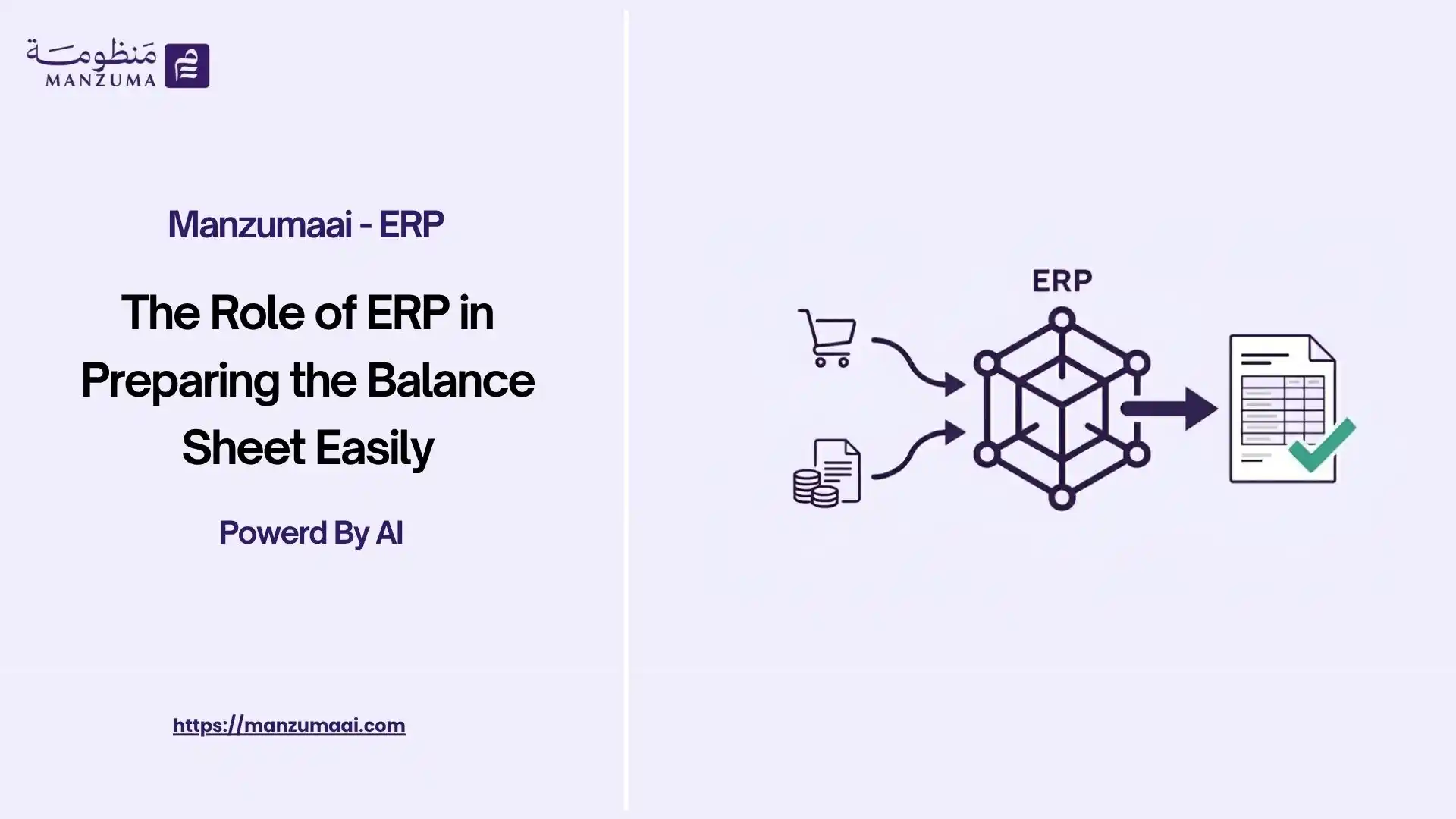
The biggest challenge in preparing financial statements is often not the accounting formula itself It is collecting validating and connecting the underlying transaction data
An integrated ERP system can connect operational transactions with accounting records For example a sales transaction can create financial information that flows into customer balances inventory records invoices and accounting reports according to the system's configuration
The same principle applies to purchasing
Purchase → Supplier invoice → Inventory or expense → Supplier balance → Accounting records
This integrated approach can reduce repetitive data entry improve visibility across
departments and make financial information easier to review The Manzuma materials describe an ERP environment that connects accounting with sales invoices purchases expenses inventory and financial reporting
Key takeaway ERP does not eliminate the need for accounting review; it organizes the data and reduces much of the manual collection and reconciliation work
How Does Manzuma AI Support Preparing the Balance Sheet?
Manzuma AI is designed around an integrated ERP approach in which core business functions operate on connected data rather than isolated records
According to the provided Manzuma materials the platform brings together
- Accounting and finance
- Sales
- E-Invoicing
- Purchases
- Expenses
- Inventory
- HR & Payroll
- Financial reporting
The platform also supports automated journal entries trial balance reporting and more than 100 financial reports along with profitability receivables payables and cash-flow-related reporting
This can make the financial reporting workflow more connected because transactions recorded across operational modules can contribute to the accounting information used in financial statements
How Does Manzuma Connect Daily Transactions to Financial Reporting?
Consider a typical sales cycle
Sales order → Invoice → Customer balance → Collection → Accounting data → Financial reports
For purchasing
Purchase → Supplier invoice → Inventory or expense → Supplier balance → Accounting data
The provided Manzuma materials specifically describe these connected transaction flows and their relationship to accounting data
This structure can help finance teams spend less time gathering information from different systems and more time reviewing the accuracy and meaning of the numbers
How Can AI Improve Financial Reporting?
Modern ERP platforms increasingly go beyond transaction processing by adding analytical capabilities
The Manzuma materials indicate that Monjez AI can be used to access reports analyze company data and generate charts using natural language
For management this can make financial information easier to explore without relying exclusively on manually prepared spreadsheets
For example a manager may need to investigate
- Changes in receivables
- Inventory levels
- Financial performance
- Outstanding balances
- Cash-flow expectations
- Financial trends
Important AI-generated insights should support financial analysis not replace appropriate accounting controls reconciliation or professional review
Why Is Preparing the Balance Sheet Important for Different Business Sectors?
The balance sheet matters across industries but the underlying operational data can vary significantly
- Trading and Distribution
- Key areas often include
- Inventory
- Customer receivables
- Supplier balances
- Cash
- Warehouses
- Sales-related accounting
Manzuma's trading and distribution solution connects inventory warehouses sales purchasing profitability and accounting processes
Professional Services
Service businesses may need greater visibility into
- Customer balances
- Projects
- Billable hours
- Expenses
- Invoicing
- Project profitability
The provided Manzuma information highlights project working-hour invoicing expense and profitability tracking for service businesses
Manufacturing businesses typically need financial data connected to operational activities such as
- Raw materials
- Production
- Inventory
- Purchasing
- Product costs
- Sales
- Accounting
The more closely these processes are connected the easier it becomes to trace the financial impact of operational activity
Construction companies may need financial visibility across
- Projects
- Contracts
- Project costs
- Purchases
- Expenses
- Customer and supplier balances
- Project profitability
For project-driven businesses connecting operational and accounting data is particularly useful for understanding the financial position behind individual projects
How Often Should a Company Prepare a Balance Sheet?
The appropriate reporting frequency depends on the company's reporting requirements accounting policies management needs and applicable regulations
Businesses may prepare financial statements
- Monthly
- Quarterly
- Annually
- At other required reporting dates
For management purposes more frequent reporting can help identify changes in working capital receivables liabilities and other financial indicators earlier
However frequency should not come at the expense of data quality A rapidly generated report based on incomplete transactions can be less useful than a properly reviewed report
What Should Businesses Look for in an ERP Financial Reporting System?
Before choosing an ERP businesses should evaluate whether the system can support the entire financial data flow rather than focusing only on accounting features
Important capabilities include
- Integrated accounting
- Sales and purchasing integration
- Inventory-accounting connectivity
- Customer and supplier management
- Automated journal entries where appropriate
- Trial balance reporting
- Financial statements
- Management dashboards
- User permissions
- Auditability and transaction tracking
- Data backup
- Scalability across users and branches
The goal is not simply to generate a balance sheet It is to create a reliable flow of financial information from the original transaction through to the final report
Final Thoughts Making Balance Sheet Preparation More Reliable
Preparing the balance sheet becomes much easier when financial data is complete properly classified and connected to the transactions that created it For growing businesses the challenge is often managing the volume and complexity of that data rather than understanding the accounting equation itself An integrated ERP can connect sales purchasing inventory expenses customers suppliers and accounting records giving finance teams a more organized foundation for financial reporting Manzuma AI extends this approach with integrated financial reporting and AI-supported data analysis helping businesses turn accounting data into more usable financial insight
What is the basic formula used when preparing the balance sheet?
The fundamental accounting equation is
Assets = Liabilities + Equity
The balance sheet should reflect this relationship after the relevant accounting records and adjustments have been completed
FAQs
Can an ERP prepare the balance sheet automatically?
An ERP can automate significant parts of the data collection classification posting and reporting process depending on its configuration However accounting teams still need to review transactions reconciliations adjustments and classifications
Why does inventory matter when preparing the balance sheet?
Inventory is generally presented as an asset and can have a significant effect on working capital Incorrect inventory records or valuation can therefore affect the reliability of the financial statement
What information should be reviewed before issuing a balance sheet?
At minimum the finance team should review relevant cash balances receivables inventory fixed assets payables loans equity period-end adjustments and reconciliations before finalizing the statement
Does a balanced balance sheet mean the accounting records are correct?
Not necessarily The accounting equation can balance even when a transaction has been recorded in the wrong account or an amount has been incorrectly classified A proper review is still required
Can Manzuma AI help businesses generate financial reports?
The provided Manzuma information indicates that the platform provides automated journal entries trial balance functionality and more than 100 financial reports alongside integrated accounting and operational modules
Ready to Organize Your Business?
Try Manzuma free for 14 days — no credit card, no commitment.