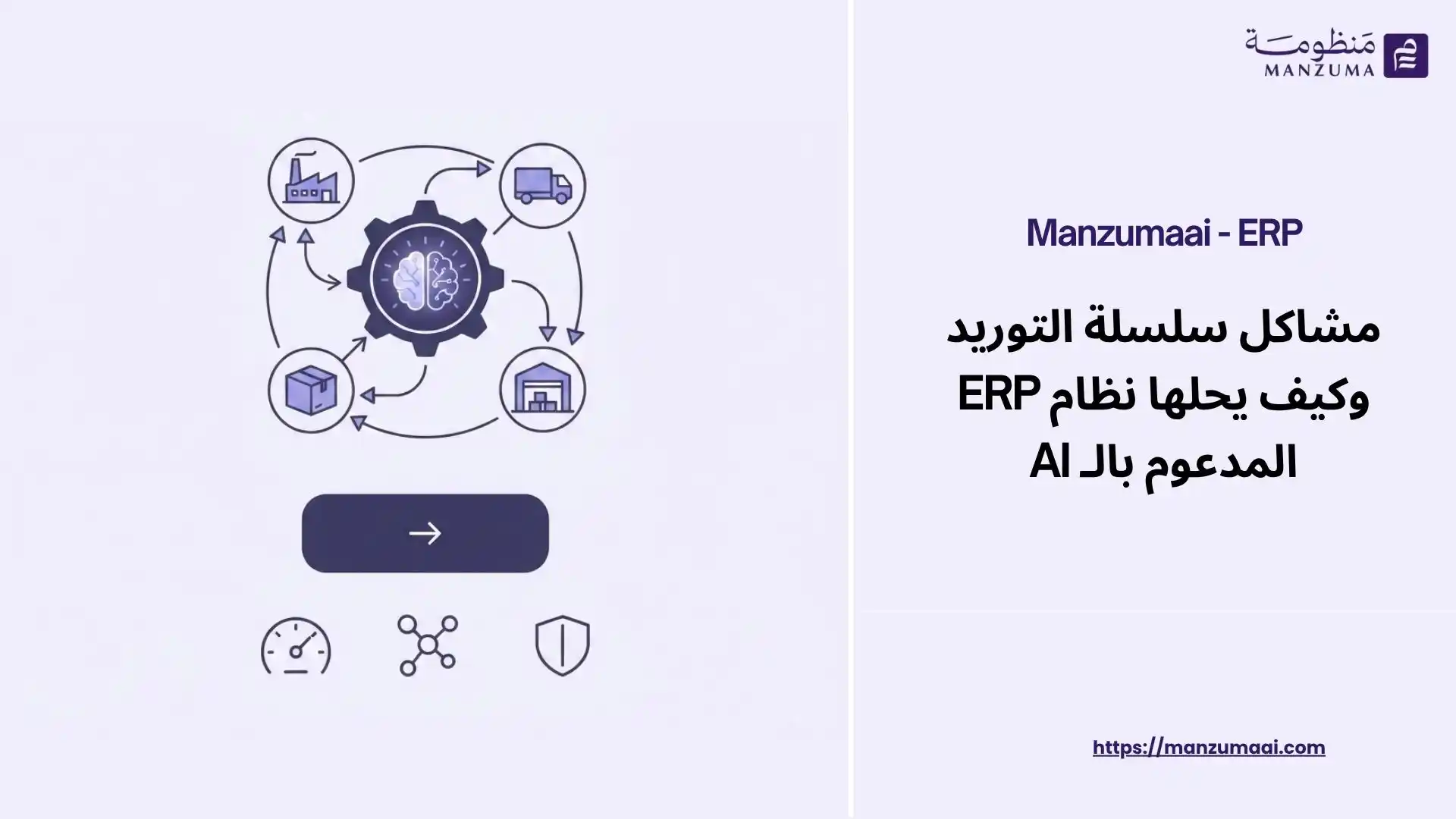
Supply chain challenges are among the most significant obstacles affecting business growth and operational stability. Delays in procurement, inventory shortages, or poor supplier management can directly impact sales, customer satisfaction, operational costs, and profitability.
Today, the supply chain is no longer just about moving products from suppliers to customers. It has evolved into a complex network that includes planning, procurement, inventory management, warehousing, production, transportation, invoicing, suppliers, and customers. As a result, a disruption in one area can quickly create problems across the entire business.
With the advancement of ERP systems, automation, and artificial intelligence (AI), organizations can now manage supply chain operations with greater accuracy, visibility, and efficiency. Instead of relying on disconnected spreadsheets and manual processes, businesses can use an integrated platform that centralizes data and streamlines workflows.
In this article, we'll explore the most common supply chain challenges, their causes, their impact on business performance, and how ERP software, automation, and AI help organizations overcome these issues while improving operational efficiency.
What Is a Supply Chain?
A supply chain encompasses all processes involved in moving products or raw materials from suppliers to end customers. These processes include procurement, storage, manufacturing, transportation, distribution, sales, and invoicing.
Simply put, the supply chain represents the complete journey of a product inside and outside an organization. The more organized and efficient this journey is, the better a company can meet customer demand, reduce costs, and enhance customer experiences.
However, when supply chain processes are poorly managed, businesses often face inventory shortages, delayed deliveries, rising costs, inaccurate forecasting, and limited supplier visibility.
Why Are Supply Chain Challenges So Critical for Businesses?
Supply chain issues affect nearly every department within an organization. They don't only impact procurement or inventory teams; they also influence sales, production, finance, customer service, and strategic planning.
For example, if products are not delivered on time, businesses may lose sales opportunities and damage customer relationships. Likewise, purchasing excessive inventory can increase storage expenses and tie up working capital. Inaccurate inventory data may even result in selling products that are unavailable.
These challenges often lead to:
- Higher operational costs
- Delayed order fulfillment
- Reduced customer satisfaction
- Financial planning difficulties
- Poor inventory control
- Increased waste and obsolete stock
- Pressure on sales and procurement teams
- Poor decision-making due to inaccurate data
That's why solving supply chain challenges is not only about improving processes—it's about protecting profitability and ensuring long-term business stability.
Common Supply Chain Challenges
1. Poor Demand Forecasting
One of the most common supply chain challenges is the inability to accurately predict customer demand. Companies may overstock slow-moving products while running out of high-demand items.
Poor demand forecasting typically results in either excess inventory or stock shortages—both of which negatively affect profitability and customer satisfaction.
An ERP system helps address this issue by analyzing historical sales data, tracking product movement, and generating insights that improve demand planning.
2. Inventory Shortages
Inventory shortages can significantly impact sales performance. When customers cannot find the products they need, they may turn to competitors.
Stockouts often occur due to inadequate inventory monitoring, delayed purchase orders, lack of automated alerts, or disconnected sales and inventory systems.
With ERP software and automation, businesses can receive low-stock alerts or automatically generate purchase orders once inventory reaches predefined reorder points.
3. Excess Inventory and Dead Stock
While inventory shortages are problematic, excess inventory can be equally damaging. Overstocking ties up capital, increases storage costs, and raises the risk of product obsolescence or expiration.
ERP systems help businesses identify fast-moving and slow-moving products, analyze sales trends, and optimize purchasing decisions based on real-time data rather than guesswork.
4. Supplier Delays
Late supplier deliveries can disrupt production schedules, inventory availability, and customer orders.
These delays often stem from poor supplier tracking, limited performance visibility, or reliance on manual communication.
ERP solutions enable organizations to monitor supplier performance, track purchase orders, compare delivery timelines, and identify the most reliable suppliers.
5. Limited Inventory Visibility
Many businesses struggle to gain accurate visibility into available inventory, reserved stock, sold products, and incoming shipments.
This lack of transparency often results in poor purchasing and sales decisions.
An ERP system provides real-time inventory visibility by connecting inventory data with sales, procurement, and warehouse operations, allowing managers to make informed decisions quickly.
6. Dependence on Manual Spreadsheets
Managing supply chain operations through spreadsheets and disconnected files may work for small businesses initially, but it becomes increasingly problematic as operations grow.
Manual processes often cause:
- Data entry errors
- Duplicate records
- Delayed updates
- Departmental silos
- Slow reporting
- Limited operational visibility
ERP software eliminates these issues by centralizing data and ensuring all departments work from a single source of truth.
7. Poor Cross-Department Collaboration
Supply chain management requires close coordination between sales, procurement, inventory, finance, and operations teams.
When departments use separate systems, communication gaps and inefficiencies emerge.
ERP platforms connect departments through shared data and workflows, improving collaboration and reducing delays.
8. Rising Transportation and Storage Costs
Transportation and warehousing expenses can quickly increase if businesses lack visibility into inventory movement and logistics costs.
Organizations may incur unnecessary expenses due to overstocking, inefficient shipping practices, or poor planning.
ERP software provides detailed cost analysis and reporting, helping companies identify savings opportunities and improve resource allocation.
9. Delayed Purchase Order Processing
Manual purchase order workflows often result in approval delays, quantity errors, and missed supplier follow-ups.
Automation streamlines the procurement process by creating structured workflows that move purchase requests through approval, ordering, receiving, invoicing, and accounting stages.
10. Difficulty Tracking Orders
End-to-end order visibility is essential for effective supply chain management.
Without clear tracking, businesses may struggle to determine whether an order has been prepared, shipped, delivered, or invoiced.
ERP systems provide real-time order tracking by connecting sales orders with inventory, logistics, invoicing, and reporting processes.
What Causes Supply Chain Problems?
Supply chain challenges often arise due to:
- Lack of an integrated business management system
- Inaccurate inventory data
- Manual processes and workflows
- Absence of automated alerts
- Poor forecasting and analytics
- Inadequate supplier performance evaluation
- Delayed internal approvals
- Disconnected sales and procurement processes
- Limited real-time reporting
- Multiple systems that do not integrate
These factors highlight that supply chain issues are often rooted in internal processes and data management—not just external market conditions.
How ERP Systems Solve Supply Chain Challenges
ERP systems improve supply chain management by connecting core business functions within a single platform.
Rather than managing procurement, inventory, finance, and sales through separate tools, ERP software provides a unified view of operations.
Key ERP capabilities include:
- Procurement and inventory integration
- Sales and order management synchronization
- Supplier management
- Purchase order tracking
- Product movement monitoring
- Invoice and accounting integration
- Real-time reporting and analytics
- Inventory cost management
- Demand planning optimization
- Reduced manual errors
The result is a more efficient, transparent, and cost-effective supply chain.
The Role of Automation in Supply Chain Management
Automation transforms repetitive manual tasks into streamlined workflows that reduce delays and human errors.
Examples of supply chain automation include:
- Low-stock notifications
- Automatic purchase order creation
- Digital approval workflows
- Automated order status updates
- Invoice-to-purchase-order matching
- Team notifications and alerts
- Real-time inventory reporting
- Dead stock monitoring
- Supplier delay alerts
- Scheduled management reports
Automation not only accelerates processes but also improves consistency, compliance, and operational control.
ERP and AI: The Future of Supply Chain Management
The future of supply chain management is increasingly driven by data, automation, and artificial intelligence.
Modern AI-powered ERP systems enable organizations to:
- Forecast demand more accurately
- Reduce stock shortages
- Minimize excess inventory
- Improve supplier performance management
- Accelerate procurement processes
- Automate reporting and analytics
- Optimize warehouse operations
- Enhance financial planning
- Lower operating costs
Companies that adopt ERP, automation, and AI early gain a competitive advantage through greater agility, visibility, and operational efficiency.
Conclusion
Supply chain challenges can significantly impact inventory management, procurement, supplier relationships, customer satisfaction, operational costs, and profitability. As businesses grow, relying on manual processes and disconnected systems increases the likelihood of errors, delays, and inefficiencies.
By implementing an AI-powered ERP system with advanced automation capabilities, organizations can streamline operations, improve inventory control, strengthen supplier management, automate procurement workflows, and gain access to real-time business insights.
If your business is struggling with inventory shortages, delayed orders, poor reporting, or disconnected processes, adopting a cloud ERP solution can be a transformative step toward building a smarter, more resilient, and future-ready supply chain.
Ready to Organize Your Business?
Try Manzuma free for 14 days — no credit card, no commitment.