- What Is Employee Time Tracking Software?
- How Does Employee Time Tracking Software Calculate Working Hours?
- What Is the Difference Between Actual Hours and Paid Hours?
- How Does Time Tracking Handle Late Arrivals, Absences, and Leave?
- How Does Employee Time Tracking Software Manage Overtime?
- How Does Time Tracking Connect Attendance With Payroll?
- How Does Attendance Data Become Payroll Data?
- What Employee Time Tracking Reports Should HR Teams Have?
- Can Time Tracking Reports Help Identify Attendance Patterns?
- Can Employee Time Tracking Software Support Multiple Branches?
- How Does ERP Software Handle Different Shifts and Work Schedules?
- Why Connect HR, Attendance, and Payroll in One ERP System?
- How Does ERP Reduce Duplicate Employee Data Entry?
- What Should You Check Before Choosing Employee Time Tracking Software?
- How Do You Choose the Right Employee Time Tracking Software?
- Why Consider Manzuma AI for Employee Time Tracking and Payroll?
- How Does Manzuma AI Connect Employee Data With Payroll?
- Which Industries Does Manzuma AI Serve for Working Hours Calculation and Payroll Integration?
- How Can You Get Started With Employee Time Tracking in Manzuma AI?
- FAQs
- Does Employee Time Tracking Software calculate working hours automatically?
- Can employee time tracking be connected to payroll?
- Does Manzuma AI provide employee attendance tracking?
- Is Manzuma suitable for businesses with multiple branches?
- Can I try Manzuma AI before subscribing?
An employee arrives early, another clocks in late, and someone else works overtime Meanwhile, the payroll team is working from spreadsheets, attendance records, and separate employee files to calculate monthly pay
As the workforce grows, these everyday details can become a serious administrative burden Manual time calculations create more opportunities for inconsistent records, duplicated data, and payroll discrepancies
The real value is not simply knowing how many hours an employee worked It is turning attendance data into reliable information that can support payroll processing, workforce administration, and management reporting
What Is Employee Time Tracking Software?
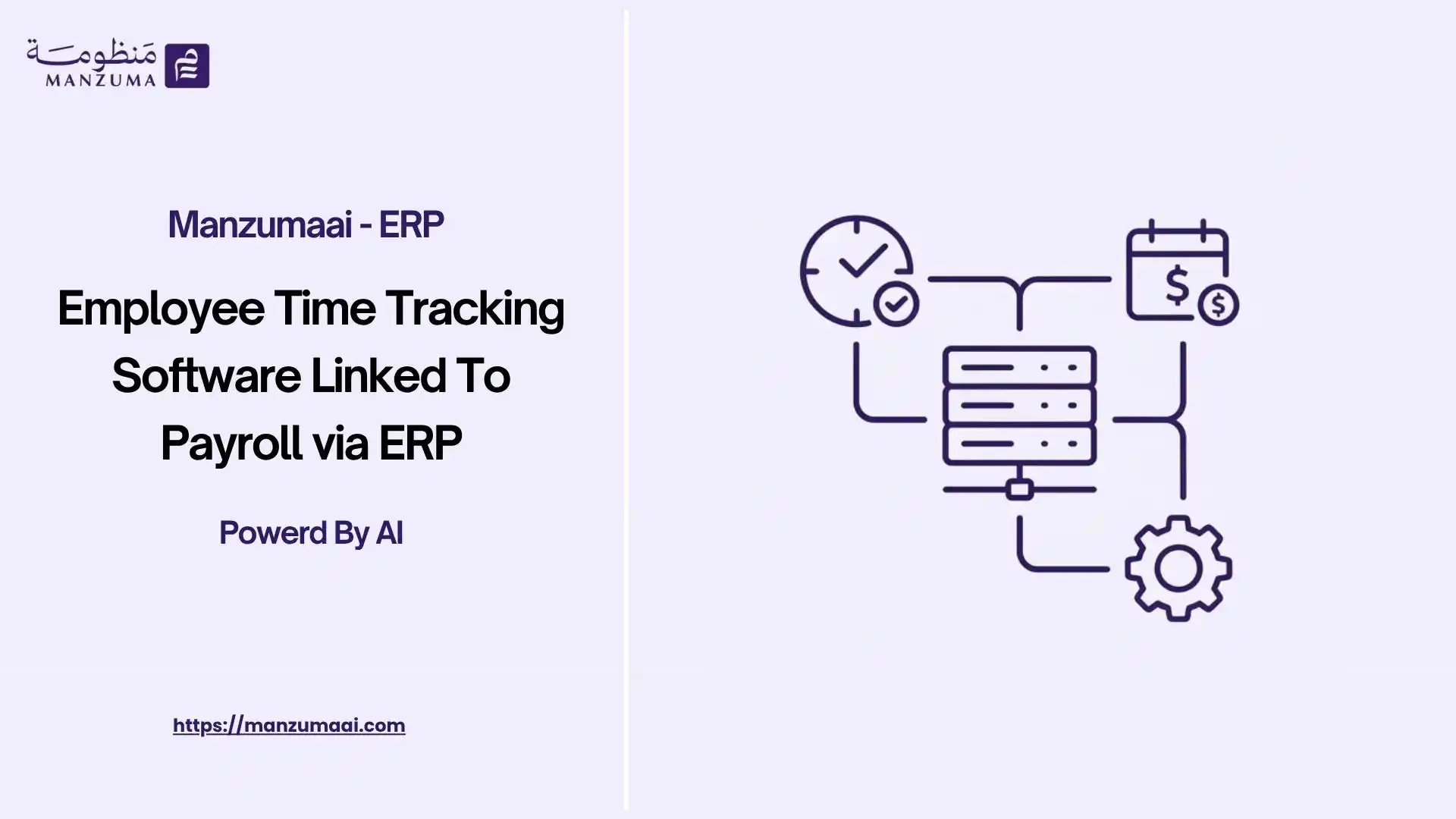
Employee Time Tracking Software is a system used to record and manage employee working hours based on attendance and company-defined work schedules
Depending on the system and its configuration, it can help businesses manage:
- Clock-in and clock-out records
- Working hours
- Employee attendance
- Late arrivals
- Early departures
- Absences
- Leave
- Overtime
- Work schedules
- Shifts
- Payroll-related time data
- HR reports
The process typically starts with an employee's attendance record The system then applies the relevant work schedule and business rules to determine how the recorded time should be classified
However, time tracking is more than subtracting clock-in time from clock-out time
A useful system must understand the rules surrounding that time and connect the resulting information with HR and payroll processes
How Does Employee Time Tracking Software Calculate Working Hours?
The basic calculation begins with recorded start and end times
For example:
Clock In → Work Period → Clock Out → Total Recorded Time
But real-world payroll calculations are rarely that simple
Employees may have:
- Different work schedules
- Break periods
- Shift patterns
- Approved leave
- Late arrivals
- Early departures
- Overtime
- Absence records
An integrated time tracking system can process attendance data according to the schedules and rules configured for the business
Manzuma AI provides employee records, attendance management, and payroll capabilities within its ERP environment, allowing attendance information to become part of a broader HR workflow
Important: The accuracy of time calculations depends on accurate attendance data and properly configured work schedules and company policies No software can compensate for incorrect source data
What Is the Difference Between Actual Hours and Paid Hours?
Actual hours refer to the time recorded through attendance data
Paid or payable hours refer to the time that qualifies for compensation according to the company's policies, employment terms, and applicable rules
These two figures may differ
For example, an employee could have recorded eight hours at the workplace but have payable time affected by approved leave, unpaid breaks, overtime rules, or other company policies
This is why an effective Employee Time Tracking Software solution should not simply calculate elapsed time It should provide the framework for applying the organization's attendance and payroll rules
How Does Time Tracking Handle Late Arrivals, Absences, and Leave?
Employee attendance should not be treated as a single number
A modern HR system can classify time-related events into different categories, such as:
- On-time attendance
- Late arrival
- Early departure
- Absence
- Approved leave
- Overtime
- Different shifts
- Alternative work schedules
This makes it easier for HR teams to review exceptions rather than manually examining every employee's attendance record
Pro Tip: Don't rely only on total hours worked Review the exceptions behind the number, including lateness, absences, leave, and overtime
Those details often provide more useful context for payroll and workforce management
How Does Employee Time Tracking Software Manage Overtime?
Overtime should be recorded separately from standard working hours so that HR and payroll teams can review it according to company policy
A connected workflow can look like:
Attendance Data → Standard Hours → Overtime → Review → Approval → Payroll
This allows managers to review overtime before approved hours are included in payroll calculations
It is important not to assume that simply recording extra working time automatically determines an employee's final overtime compensation
The system should support the specific overtime rules and payroll configuration required by the organization
How Does Time Tracking Connect Attendance With Payroll?
Technical insight: Integrating attendance and payroll reduces the need to manually transfer working-hour data between separate systems
A connected HR workflow can follow these stages:
- Employee attendance is recorded
- Attendance exceptions are reviewed
- Overtime and leave are processed
- Relevant time data is approved
- Approved information becomes available for payroll processing
- Payroll calculations are completed according to the configured rules
Manzuma AI brings employee records, attendance, and payroll together within a cloud ERP environment
This allows time-related employee data to remain connected rather than requiring HR teams to manually copy figures from attendance reports into payroll spreadsheets
Best Employee Time Tracking Software
Why Does Payroll Integration Reduce Manual Errors?
When attendance and payroll are managed in separate systems, HR employees may have to manually transfer:
- Working hours
- Late arrivals
- Absences
- Leave
- Overtime
- Employee information
Every additional manual transfer creates another opportunity for an incorrect entry or inconsistent record
With integrated HR and payroll workflows, approved attendance information can move through the same system instead of being repeatedly copied between files
The objective of automation is not to eliminate human review
It is to reduce repetitive administrative work while keeping appropriate controls and approval steps in place
How Does Attendance Data Become Payroll Data?
A structured payroll workflow can be divided into five stages:
1- Record Attendance
Capture employee clock-in and clock-out information
2- Review Attendance Exceptions
Check late arrivals, absences, early departures, leave, and other exceptions
3- Review Overtime and Entitlements
Verify overtime and other time-related items according to company policies
4- Approve Employee Data
Make sure the information going into payroll has been reviewed and approved by the appropriate users
5- Process Payroll
Use the approved employee and attendance information as part of the payroll calculation
This approach creates a clearer audit trail and reduces dependence on manually consolidated attendance spreadsheets
What Employee Time Tracking Reports Should HR Teams Have?
Reporting turns daily attendance records into information that HR and management can review
Useful reports may include:
| Report | Business Use |
| Attendance Report | Monitor employee attendance patterns |
| Late Arrival Report | Identify recurring lateness |
| Absence Report | Review employee absences |
| Overtime Report | Monitor additional working hours |
| Leave Report | Track leave usage and balances |
| Employee Records | Access centralized employee information |
| Payroll Report | Review payroll-related data |
| Time Summary | Analyze working-hour patterns |
The exact reports required depend on the company's policies, workforce structure, and payroll process
The important factor is whether the reporting system provides enough detail to explain the numbers rather than simply presenting a total
Can Time Tracking Reports Help Identify Attendance Patterns?
Yes Attendance reports can help HR teams identify recurring patterns, such as frequent late arrivals or unusually high overtime in a particular department
For example, management may notice that:
- Overtime is concentrated in one department
- Late arrivals occur repeatedly within a specific team
- Certain shifts consistently require additional hours
- Absence patterns are increasing during a particular period
- However, working hours should not be treated as a standalone measure of productivity
- More hours at work do not automatically mean higher output
For a meaningful workforce analysis, attendance information should be considered alongside the performance indicators relevant to each role
Can Employee Time Tracking Software Support Multiple Branches?
Yes, provided the system supports centralized employee management with appropriate branch-level permissions and access controls
A multi-branch business may need to manage employees across different locations while maintaining centralized HR records
An ERP-based approach can help organizations manage:
- Employees by branch
- User permissions
- Attendance records
- Work schedules
- HR information
- Payroll data
- Centralized reports
Manzuma AI provides a cloud-based environment designed to support business operations across multiple locations, with centralized management and user permissions
How Does ERP Software Handle Different Shifts and Work Schedules?
Not every employee follows the same schedule
A company may have:
- Morning shifts
- Evening shifts
- Rotating shifts
- Department-specific schedules
- Flexible working arrangements
- Different schedules for different employee groups
This makes configurable work schedules an important consideration when choosing Employee Time Tracking Software
Before implementation, businesses should confirm that the system can handle the scheduling rules they actually use instead of assuming that every employee follows a single standard timetable
Why Connect HR, Attendance, and Payroll in One ERP System?
When HR, attendance, and payroll operate within the same ERP environment, employee information can remain connected across the relevant business processes
Instead of maintaining separate databases for:
Employee Records | Attendance | Payroll
the ERP can create a connected employee-management workflow
Manzuma AI integrates HR and payroll capabilities with other business functions such as accounting, sales, inventory, and reportingThis creates a broader business environment where employee-related information can coexist with the company's financial and operational data
How Does ERP Reduce Duplicate Employee Data Entry?
Technical fact: Every time the same information is manually re-entered into another system, there is a potential for inconsistency
For example, an employee's information might exist in:
- An HR spreadsheet
- An attendance application
- A payroll file
- An accounting system
An integrated ERP aims to centralize employee information so connected modules can use the same underlying records according to user permissions and system configuration
This can reduce unnecessary duplication and make it easier to maintain consistent employee data across HR workflows
What Should You Check Before Choosing Employee Time Tracking Software?
Before selecting a time tracking solution, evaluate how it handles the complete employee attendance lifecycle
Look for:
Attendance and clock-in/clock-out management
Work schedules
Shift management
Late arrivals
Absence tracking
Leave management
Overtime
Payroll integration
Employee records
HR reporting
User permissions
Activity or audit records
Multi-branch support
Scalability
Data security
Technical support
Ease of use and training
Pro Tip: Test the software with a realistic employee scenario
For example, create an employee who has a late arrival, approved leave, and overtime during the same payroll period Then check whether the system processes each event correctly and presents the resulting data clearly
How Do You Choose the Right Employee Time Tracking Software?
Start with your workforce—not the software's feature list
- First, define:
- Number of employees
- Number of branches
- Work schedules and shifts
- Attendance rules
- Late and absence policies
- Overtime rules
- Leave policies
- Payroll requirements
- HR reporting needs
- User roles and permissions
Then evaluate whether the system can connect attendance, employee records, HR processes, and payroll within one coherent workflow
Scalability should also be part of the decision
The system should be able to accommodate additional employees, branches, users, and increasingly complex HR processes as the organization grows
Why Consider Manzuma AI for Employee Time Tracking and Payroll?
Manzuma AI provides a cloud-based ERP platform that brings HR and payroll together with accounting and other core business operations
Its HR capabilities include employee records, attendance, payroll, leave-related functions, and user permissions
This integrated structure can be useful for organizations that want to manage employee information and attendance without maintaining a separate application for every HR process
The platform also includes Munjiz AI, an AI-powered assistant designed to help users retrieve reports, analyze business data, and access information through natural-language interactions
For businesses already looking to centralize their operational and financial systems, having HR and payroll within the same ERP environment can reduce the need to switch between disconnected applications
How Does Manzuma AI Connect Employee Data With Payroll?
Manzuma's ERP environment brings employee records, attendance, and payroll into a connected HR workflow
A simplified process can be represented as:
Employee Record → Attendance → Leave & Overtime → Review → Payroll → Reports
At the same time, the ERP can connect HR-related information with other business functions, including accounting and reporting
This gives management a broader view of company operations without requiring HR teams to maintain completely separate systems for each process
Which Industries Does Manzuma AI Serve for Working Hours Calculation and Payroll Integration?
Manzuma AI helps businesses across various industries organize employee data, track attendance and working hours, and connect this information with payroll management through an integrated ERP system. This makes it easier to monitor working hours and improve payroll accuracy.
- Manufacturing: Track employee attendance, working hours, and shifts while linking time records to payroll and operating costs.
- Construction: Monitor working hours across different project teams to support labor cost calculations and payroll reviews.
- Services and Consulting: Track the time employees spend on tasks and projects to measure service costs and manage resources more effectively.
- Trading and Distribution: Manage attendance records for sales teams, warehouse staff, and branch employees while simplifying payroll data management.
- Restaurants and Hospitality: Manage shift schedules and track employee working hours to support payroll management across different work schedules.
- Healthcare: Organize employee schedules, monitor attendance, and manage shift records to simplify payroll processing.
How Can You Get Started With Employee Time Tracking in Manzuma AI?
A successful implementation starts with clearly defining your company's attendance and payroll requirements
Step 1: Define Your Workforce Structure
Document employees, departments, branches, and reporting relationships
Step 2: Configure Work Schedules
Set up the working hours and shifts applicable to different employee groups
Step 3: Define Attendance Rules
Determine how lateness, early departures, absences, leave, and overtime should be handled
Step 4: Configure Payroll Requirements
Make sure the payroll process reflects the company's compensation rules and approved attendance dataStep 5: Set User Permissions
Define who can view, review, approve, or modify attendance and payroll information
Step 6: Test Real Employee Scenarios
Run sample cases involving normal attendance, overtime, leave, lateness, and absence
Step 7: Train the HR and Payroll Teams
Make sure employees responsible for attendance and payroll understand the complete workflow
Employee Time Tracking Software is no longer simply a tool for calculating the difference between clock-in and clock-out times
Its real value comes from connecting attendance data with employee records, work schedules, leave, overtime, payroll, and HR reporting
For growing businesses, an ERP-based approach can reduce repetitive data entry and create a more consistent flow of employee information across HR and payroll processes
With its cloud-based ERP platform, HR and payroll capabilities, attendance management, reporting, and AI-powered assistance through Munjiz AI, Manzuma provides a centralized environment for managing employee time and connecting it with the wider business operation
Manzuma offers a 14-day free trial without requiring a credit card, allowing businesses to explore the platform before committing to a subscription
FAQs
Does Employee Time Tracking Software calculate working hours automatically?
It can calculate working hours based on recorded attendance and configured work schedules, with the exact calculation rules depending on the software and company setup
Can employee time tracking be connected to payroll?
Yes When attendance, HR, and payroll are integrated, approved time data can be used as part of the payroll process
Does Manzuma AI provide employee attendance tracking?
Yes Manzuma provides attendance management as part of its HR and payroll capabilities within its cloud ERP platform
Is Manzuma suitable for businesses with multiple branches?
Manzuma supports cloud-based business management across multiple locations, with user and permission management that can be configured according to the organization's structure
Can I try Manzuma AI before subscribing?
Yes Manzuma offers a 14-day free trial without requiring a credit card
Ready to Organize Your Business?
Try Manzuma free for 14 days — no credit card, no commitment.