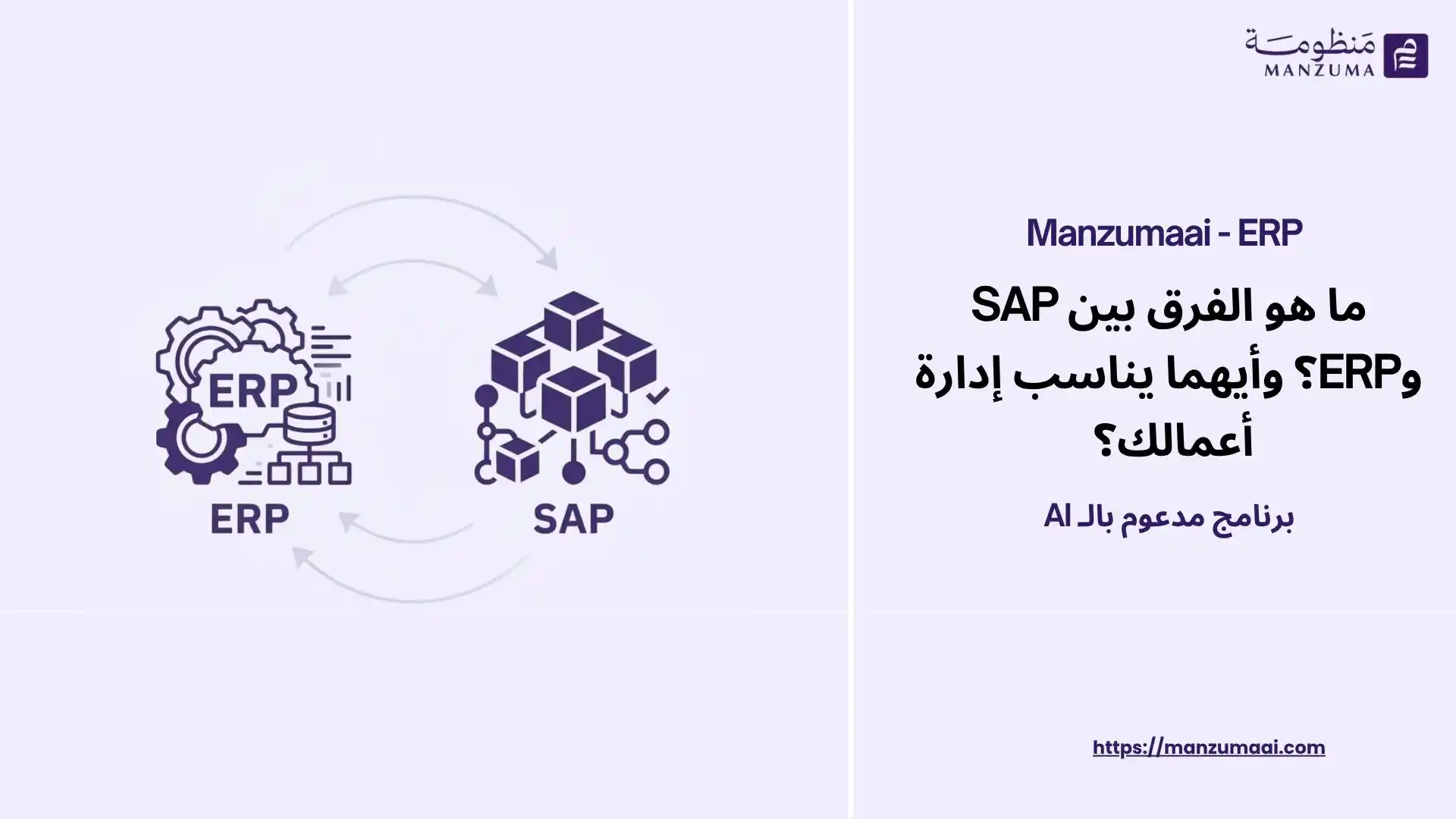
Confusion often begins when a company starts looking for a business management system and comes across terms like SAP and ERP, treating them as competing solutions of the same type. However, the reality is different. ERP refers to a type of business management system, while SAP is a company that provides a wide range of solutions, including ERP solutions.
Understanding the difference between the two terms is therefore the first step toward choosing the right system. The right decision should not be based on how well-known a name is, but rather on the company’s needs, the nature of its operations, and its growth plans.
What Is the Difference Between SAP and ERP? And Why Are the Terms Often Confused by Business Owners?
The direct answer is that ERP describes a category of business software, while SAP is the name of a company and a portfolio of software solutions.
ERP stands for Enterprise Resource Planning. It refers to a system designed to connect a company’s core business processes within an integrated environment, including accounting, sales, purchasing, inventory, human resources, manufacturing, and supply chain management.
SAP, on the other hand, is a global technology company that develops business management solutions. Its portfolio includes ERP solutions such as SAP Cloud ERP, SAP S/4HANA Cloud, and SAP Business One, as well as other solutions for data management, human resources, supply chain management, customer experience, and more.
Therefore, the right question is not, “Should I choose SAP or ERP?” because SAP itself can be an ERP provider. The better question is: **Which ERP solution best fits my company’s operations and business needs?
What Is an ERP System and How Does Enterprise Resource Planning Work?
An ERP system is a software solution designed to connect a company’s core business processes instead of having each department rely on separate tools.
For example, when a sales transaction is recorded, it can be linked to the invoice, customer account, inventory, revenue, and financial reports, depending on the system’s configuration and the modules being used.
The real value of ERP lies in preventing data from becoming isolated across different departments. The accounting team can access financial data generated by business operations, management can monitor reports, inventory can be updated based on sales and purchasing activities, while the HR department can manage employee records and payroll within the same environment.
This integration is at the heart of modern ERP systems.
What Business Processes Can an ERP System Integrate?
Depending on the system and the company’s industry, an ERP platform can bring together:
* Accounting and financial management.
* Sales and invoicing.
* Purchasing and expenses.
* Inventory and warehouse management.
* Human resources and payroll.
* Manufacturing and quality management.
* Point-of-sale (POS) operations.
* Reporting and analytics.
* Customer and relationship management.
* Integration with other systems and applications.
Ready to Organize Your Business?
Try Manzuma free for 14 days — no credit card, no commitment.