- What Is a Contract Lifecycle Management System?
- Why Does Contract Management Become More Difficult as a Business Grows?
- What Problems Can a Contract Management System Help Solve?
- How Does CLM Manage the Contract Lifecycle From Creation to Renewal?
- Why Integrate a Contract Lifecycle Management System With ERP?
- How Can CLM and ERP Connect Contracts With Sales, Purchasing, and Accounting?
- How Can Contract Data Support Better Financial and Operational Decisions?
- How Can an Integrated System Help Track Contract Obligations and Deadlines?
- How Can a Contract Management System Improve Governance and Control?
- How Can Employees Access Contract Information Faster?
- What Can Management Analyze After Connecting Contracts With ERP Data?
- What Features Should You Look for in a Contract Lifecycle Management System?
- Should You Choose a Standalone CLM or an ERP-Integrated Solution?
- Can a Contract Lifecycle Management System Scale With Business Growth?
- How Do You Choose the Right Contract Lifecycle Management System?
- Why Is Manzuma AI the Best ERP System to Integrate with Your Contract Management System?
- What Industries Does Manzuma AI Contract Management Serve?
- How Can Manzuma AI Support Connected Contract Management?
- Why Does ERP Integration Matter for Contract Management?
- How Can You Get Started With Integrated Contract Management?
- FAQs
- What is a Contract Lifecycle Management System?
- What is the difference between CLM and ERP?
- Why integrate CLM with ERP?
- Can CLM reduce duplicate data entry?
- Does every ERP include a full CLM module?
A contract might start as a simple document, but managing it becomes much more complicated as a business grows
One copy may sit in an employee’s inbox, another may be saved on a manager’s computer, while renewal dates are tracked in an Excel spreadsheet As the number of customers, suppliers, projects, and branches increases, keeping track of agreements, obligations, payments, and deadlines can quickly become a time-consuming administrative task
What Is a Contract Lifecycle Management System?
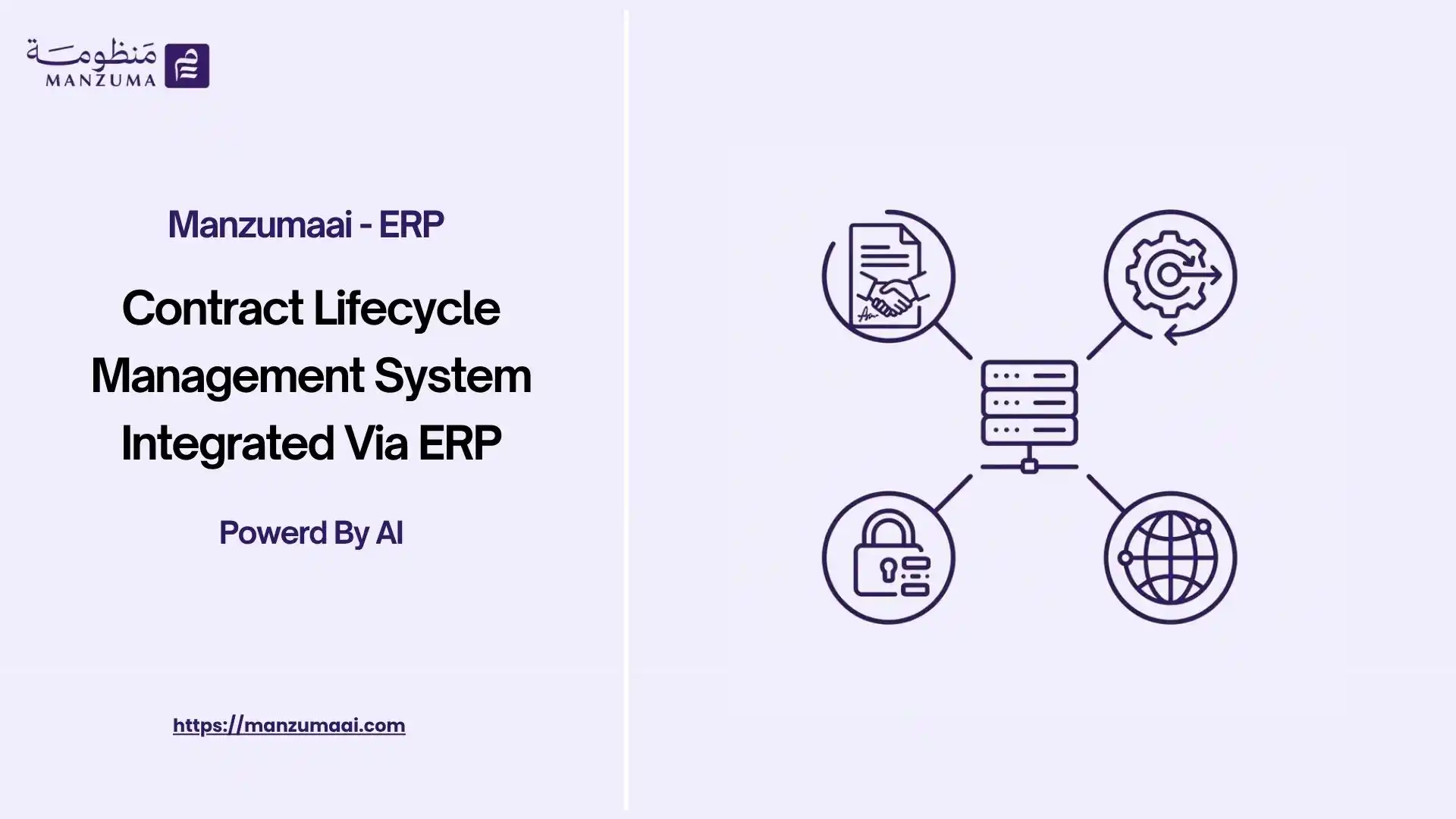
A Contract Lifecycle Management System (CLM) is software designed to manage contracts throughout their lifecycle—from drafting and review to approval, execution, monitoring, renewal, or termination
A modern CLM solution goes beyond digital document storage It turns contract information into structured business data that can be searched, monitored, analyzed, and connected to related processes
A typical contract lifecycle may include:
- Contract creation and drafting
- Review and negotiation
- Approval and authorization
- Execution and record keeping
- Obligation and deadline tracking
- Financial and operational follow-up
- Renewal or termination
- Reporting and contract analysis
Key takeaway: Contract management is not simply about storing agreements It is about managing the information and business activities connected to those agreements
Why Does Contract Management Become More Difficult as a Business Grows?
Growth creates more than additional revenue It also creates more operational relationships
A growing company may have more customers, suppliers, employees, projects, branches, recurring agreements, payment terms, service commitments, and renewal dates to manage
When this information is stored across separate folders, email threads, spreadsheets, and applications, employees may spend more time searching for information and verifying which version of a contract is current
The challenge becomes even greater when contract information is disconnected from the transactions generated by the agreement
For example, knowing that a supplier contract exists is useful Knowing the supplier, purchase activity, invoices, payments, expenses, renewal date, and related obligations is much more useful for operational decision-making
What Problems Can a Contract Management System Help Solve?
A structured contract management environment can help businesses address common challenges such as:
- Difficulty locating the correct contract version
- Missed renewal or expiration dates
- Scattered customer and supplier information
- Limited visibility into contractual obligations
- Repeated data entry across different systems
- Manual contract-related reporting
- Difficulty connecting agreements with financial transactions
- Limited visibility across departments
The objective is not simply to digitize paperwork The objective is to make contract information easier to manage throughout the business processHow Is CLM Different From
Traditional Contract Storage?
Storing a contract and managing a contract are two different things
Traditional document storage focuses primarily on keeping the file somewhere accessible Employees may still need to search emails, folders, spreadsheets, and financial systems to understand what the agreement means for the business
A CLM environment, by contrast, is designed around the contract lifecycle
It can organize the agreement, its parties, important dates, approval status, obligations, and related information in a structured way
Pro Tip: Do not evaluate contract software based only on how many documents it can store Evaluate how effectively it connects contract information with the business activities that depend on those contracts
How Does CLM Manage the Contract Lifecycle From Creation to Renewal?
A structured contract workflow can make each stage easier to track
Draft the Contract
Create the agreement and capture essential information about the parties, terms, dates, and commercial conditions
Review and Approve
Route the contract through the appropriate review and approval process based on organizational roles and permissions
Execute and Record
Store the finalized agreement and associate it with the relevant customer, supplier, project, branch, or business process
Monitor Obligations
Track important dates, payments, commitments, and operational requirements throughout the contract period
Manage Renewals and Expiration
Use reminders and structured records to make upcoming renewals or expirations visible before action is required
Report and Analyze
Use contract information alongside operational and financial data to understand the broader impact of agreements
This lifecycle approach helps move contract management from reactive document searching to proactive operational management
Why Integrate a Contract Lifecycle Management System With ERP?
The greatest value often appears when contract information does not remain isolated from the rest of the business
ERP software is designed to connect business functions such as sales, invoicing, purchasing, inventory, accounting, HR, projects, and reporting
When contract-related information is connected to these processes, the contract becomes part of the operational workflow rather than a separate document sitting outside it
For example:
Customer Contract → Sales → Invoice → Payment → Accounting → Reporting
Another workflow could be:
Supplier Contract → Purchasing → inventory or Expense → Invoice → Payment → Accounting
For a project-based business, the relationship could extend to:
Project Contract → Project Costs → Expenses → Billing → Revenue → Project Profitability
The exact workflow depends on the business model and system configuration, but the principle remains the same: connect the agreement with the transactions and processes it creates
How Can CLM and ERP Connect Contracts With Sales, Purchasing, and Accounting?
The relationship between a contract and ERP processes depends on the type of agreement
| Contract Type | Potential ERP Connection |
| Customer contract | Sales, invoicing, receivables, and payments |
| Supplier agreement | Purchasing, expenses, payables, and payments |
| Project contract | Project costs, billing, revenue, and profitability |
| Recurring agreement | Renewal dates, recurring transactions, and reporting |
| Multi-branch agreement | Branch operations and consolidated reporting |
This type of integration gives teams a broader operational context
Instead of viewing the contract separately from the transactions it generates, users can connect the agreement to the relevant business records
How Does ERP Integration Reduce Duplicate Data Entry?
Duplicate data entry becomes a major issue when contract information and operational data live in separate systems
For example, if customer information already exists in an ERP platform, manually recreating the same customer record in another application increases administrative work and creates opportunities for inconsistent information
An integrated environment can reduce the need to repeatedly recreate information across systems
This can improve consistency between:
- Customer records
- Supplier records
- Sales transactions
- Purchase transactions
- E-Invoicing
- Payments
- Accounting records
- Project information
- Contract details
Key insight: The more connected the data, the less businesses need to rely on manual transfers between departments and applications
How Can Contract Data Support Better Financial and Operational Decisions?
A contract becomes much more useful when management can understand its business impact
Instead of asking only:
“Where is the contract?”
management can ask:
“What does this contract mean for our revenue, costs, payments, projects, and future obligations?”
For example, a customer agreement may be connected to sales and invoicing data, while a supplier agreement may be associated with purchasing expenses and payments
For project-based businesses, linking contractual information with project costs, billing, and profitability can provide additional context for financial analysis
This is one of the key advantages of connecting contract management with ERP: the agreement becomes part of the broader business data environment
How Can an Integrated System Help Track Contract Obligations and Deadlines?
Contract management requires more than keeping a signed document on file
Businesses may need to monitor:
- Renewal dates
- Expiration dates
- Payment schedules
- Service obligations
- Deliverables
- Approval requirements
- Contract status
- Financial commitments
- Related operational activities
Early reminders can turn important dates from hidden information inside a document into actionable business events
Reporting adds another layer of visibility by helping teams identify agreements that require attention without manually reviewing every contract
Important: Alerts are only useful when the underlying contract data and dates are entered correctly and maintained properly
How Can a Contract Management System Improve Governance and Control?
As contract volumes increase, businesses need clear ownership and access controls
A structured system can support governance by helping organizations define:
- Who can access contract information
- Who can create or modify records
- Who can approve agreements
- Which departments are responsible for follow-up
- Which activities need management review
- Which information should be available through reports
Role-based access is particularly important when contracts contain commercially sensitive information
An ERP environment with configurable user roles and permissions can provide a broader framework for controlling access to business dataWhat Role Do Alerts and Reporting Play in Contract Management?
A renewal date hidden inside a contract is easy to overlook
A structured reminder associated with that contract creates an opportunity for the responsible team to act before the deadline
Reporting provides a broader management view
Instead of reviewing contracts individually, management can analyze relevant agreements based on criteria such as:
- Active or expired status
- Customer or supplier
- Branch
- Project
- Contract period
- Upcoming renewal
- Related financial activity
- Operational responsibility
This makes contract reporting more useful as a management tool rather than simply an administrative archive
How Can Employees Access Contract Information Faster?
A contract management process should make important information easier to find
Users may need to know:
- Who is the contracting party?
- What is the current contract status?
- When does it expire?
- When is it due for renewal?
- Which project or transaction is associated with it?
- What financial activity is related to it?
- Who is responsible for follow-up?
Centralizing and structuring this information can reduce the time employees spend searching across email, spreadsheets, folders, and disconnected applications
The goal is not simply faster document retrieval It is faster access to the business context surrounding the contract
What Can Management Analyze After Connecting Contracts With ERP Data?
Depending on the system's capabilities and configuration, contract-related analysis may include:
- Active and expired contracts
- Contracts by customer or supplier
- Upcoming renewals
- Contract-related payments
- Agreements by branch
- Agreements by project
- Revenue associated with customer contracts
- Expenses associated with supplier agreements
- Project profitability related to contractual work
- Operational obligations requiring follow-up
This broader view can help management understand contracts as business relationships rather than isolated documents
What Features Should You Look for in a Contract Lifecycle Management System?
The right feature set depends on the company's requirements, but important capabilities may include:
- Centralized contract information
- Contract lifecycle tracking
- Searchable contract records
- User roles and permissions
- Approval workflows
- Renewal and expiration reminders
- Contract-related reporting
- Customer and supplier integration
- Accounting integration
- Purchasing and sales integration
- Project integration where required
- Multi-branch support
- Cloud accessibility
- Scalability
The most important factor is not the number of features It is how well those features work together within the company's actual operating model
Should You Choose a Standalone CLM or an ERP-Integrated Solution?
The answer depends on how contracts are used within the business
A standalone CLM platform may be appropriate when the primary requirement is specialized contract management
An ERP-integrated approach can be particularly relevant when contracts are closely connected to sales, purchasing, accounting, inventory, projects, payments, or other operational processes
For example, if a contract directly influences invoices, supplier purchases, project costs, or financial reporting, keeping contract information completely separate may create additional data-transfer requirements
Key consideration: The right architecture depends on whether contract management is primarily a document-focused requirement or a core part of the company's broader operational workflow
Can a Contract Lifecycle Management System Scale With Business Growth?
Contract complexity often increases alongside business growth
More customers can mean more agreements More suppliers can create more purchasing contracts New branches introduce additional business relationships Expanding project operations can generate more project-specific agreements
A scalable system should therefore be able to support increasing numbers of:
- Users
- Contracts
- Transactions
- Customers and suppliers
- Branches
- Projects
- Reports
- Business processes
Cloud-based ERP environments can provide a foundation for scaling operations without requiring every department to maintain separate local systems
How Do You Choose the Right Contract Lifecycle Management System?
Choosing a CLM solution should begin with your business processes rather than a feature checklist
Before selecting a system, identify:
- The types of contracts your company manages
- The number of users who need access
- The departments involved in contract workflows
- The number of branches or business units
- The customers and suppliers associated with agreements
- The financial processes connected to contracts
- Required approval workflows
- Reporting requirements
- Renewal and expiration tracking needs
- Integration requirements with ERP and other systems
- Then test the platform against real workflows
Pro Tip: Instead of asking only, “Does the system have contract management features?”, ask, “Can it support the complete workflow from contract creation to the financial and operational activities generated by that contract?”
Why Is Manzuma AI the Best ERP System to Integrate with Your Contract Management System?
When it comes to integrating your Contract Lifecycle Management System with an ERP platform, Manzuma AI provides the flexibility, connectivity, and centralized data management your business needs. With Manzuma AI, you can connect contract data directly with your core financial and operational processes, creating a more efficient and connected workflow.
- Seamless Integration: Connect your Contract Lifecycle Management System with your ERP processes for a unified flow of information.
- Centralized Data: Keep contract, financial, purchasing, sales, and supplier data connected in one platform.
- Reduced Manual Work: Automate data transfer and minimize repetitive data entry across departments.
- Improved Data Accuracy: Reduce errors caused by duplicate or manually entered information.
- Real-Time Visibility: Access up-to-date financial and operational data to support faster decision-making.
- Scalable Solution: Adapt the system to your business needs as your operations and contract volume grow.
- Better Operational Efficiency: Bring contracts and ERP processes together to streamline workflows and improve overall productivity.
With Manzuma AI, your Contract Lifecycle Management System and ERP work together as one connected ecosystem, giving your business greater control, efficiency, and visibility.
What Industries Does Manzuma AI Contract Management Serve?
Manzuma AI helps businesses across various industries streamline and unify their financial and operational processes through a comprehensive cloud-based ERP system, including:
- Trading & Distribution: Manage sales, purchasing, inventory, suppliers, customers, and operations across multiple branches.
- Manufacturing: Manage production, raw materials, inventory, purchasing, quality, and costs efficiently.
- Services: Streamline financial operations, customer management, invoicing, expenses, and human resources.
- Construction: Manage projects, contracts, costs, purchasing, inventory, and cash flow while connecting different departments through a unified system.
- Restaurants & Hospitality: Manage sales, point-of-sale operations, inventory, purchasing, and accounting from one platform.
- Healthcare: Streamline administrative and financial operations while efficiently managing resources and inventory.
Most importantly, for industries that rely on a large number of contracts with customers, suppliers, and contractors, integrating a Contract Lifecycle Management System with an ERP system provides a powerful way to connect contract data with financial and operational processes, reduce manual data entry, and improve data accuracy.
How Can Manzuma AI Support Connected Contract Management?
Manzuma AI is a cloud ERP platform designed to bring core business functions into a connected business environment
Its broader ERP ecosystem includes areas such as:
- Sales and invoicing
- Purchasing and expenses
- Inventory and warehouses
- Accounting and financial reporting
- HR and payroll
- Manufacturing and quality management
- Customer and operational data
- AI-powered assistance through Munjiz AI
This means the value for contract-related workflows comes from the surrounding ERP environment and the ability to connect business operations rather than simply storing contract documents
For example, when an agreement is related to a customer, supplier, purchase, invoice, project, or financial transaction, having those business records within a connected ERP environment can reduce the need to reconstruct the relationship manually across multiple application
Important: Whether a specific CLM workflow is available depends on the product's current functionality and configuration Businesses should verify the exact contract creation, approval, reminder, renewal, and integration capabilities required for their use case before implementation
Why Does ERP Integration Matter for Contract Management?
Contract management becomes more valuable when the contract is connected to the work it governs
- A customer agreement can be related to sales and invoices
- A supplier agreement can be related to purchasing and payments
- A project contract can be related to costs, billing, revenue, and profitability
- A recurring agreement can be associated with renewal dates and recurring business activity
This creates a more complete operational picture and reduces the need to manage contracts as isolated documents
Ultimately, a Contract Lifecycle Management System should help businesses move beyond document storage toward structured, connected, and actionable contract information
How Can You Get Started With Integrated Contract Management?
Start by mapping your current contract workflow
Identify where contracts are stored, who reviews them, how approvals are handled, where renewal dates are tracked, and which financial or operational processes depend on each agreement
Then identify the points where employees repeatedly search for information, re-enter data, or move information between applications
Once these gaps are clear, evaluate whether an integrated ERP environment can address them alongside your existing business processes
For companies considering Manzuma AI, the next step is to discuss the organization's specific workflows and determine which ERP configuration can support its operational requirements
Contracts should not become isolated documents that employees have to search for whenever a renewal, payment, project, or business decision comes up
A modern Contract Lifecycle Management System can organize agreements throughout their lifecycle, while ERP integration can connect those agreements with the operational and financial activities they generate
FAQs
What is a Contract Lifecycle Management System?
A Contract Lifecycle Management System is software designed to organize and manage contracts from drafting and approval through execution, monitoring, renewal, or termination
What is the difference between CLM and ERP?
CLM focuses specifically on contract processes, while ERP connects broader business functions such as sales, purchasing, accounting, inventory, HR, and reporting
Why integrate CLM with ERP?
Integration can connect contracts with the sales, purchasing, accounting, project, and financial processes associated with them, reducing disconnected data and manual transfers
Can CLM reduce duplicate data entry?
Yes When contract-related information is connected to existing customer, supplier, project, or financial records, businesses may reduce the need to recreate the same information in multiple systems
Does every ERP include a full CLM module?
No Contract functionality varies by ERP platform Businesses should verify the specific lifecycle, approval, reminder, renewal, and reporting capabilities they require
Ready to Organize Your Business?
Try Manzuma free for 14 days — no credit card, no commitment.