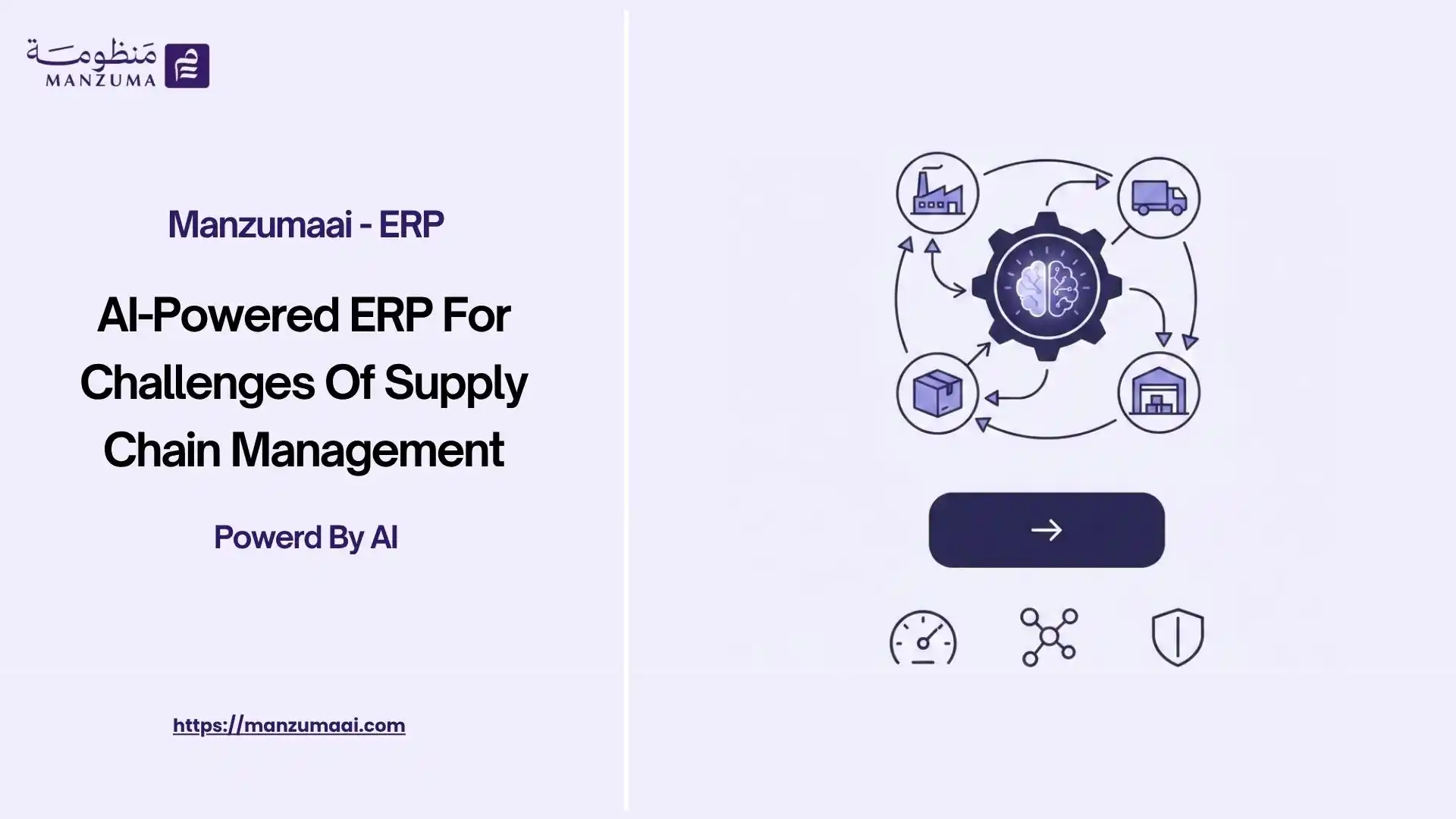
- What Is a Supply Chain?
- Why Are Supply Chain Challenges So Critical for Businesses?
- Common Challenges Of Supply Chain Management
- What Causes Challenges Of Supply Chain Management?
- How ERP Systems Solve Challenges Of Supply Chain Management
- The Role of Automation in Supply Chain Management
- How Does ERP Improve Purchasing Management?
- How Does ERP Improve Inventory Management?
- How Does ERP Help Evaluate Suppliers?
- The Role of Reports in Solving Supply Chain Problems
- How Does Manzuma AI Help Manage the Supply Chain?
- Manzuma AI And Automation: Faster Operations, Better Decisions
- Benefits of Using ERP for Supply Chain Management
- How Do You Know Your Business Needs ERP for Supply Chain Management?
- How to Choose the Right ERP System for Supply Chain Management
- The Future of Supply Chain Management With ERP and AI
- How Does Manzuma AI Help Industries Address Supply Chain Problems?
- Why Choose Manzuma AI for Supply Chain Management?
- FAQs
- What Is the Role of Automation in Supply Chain Management?
- How Can Businesses Reduce Inventory Shortages?
- Is Manzuma AI Suitable for Small and Medium-Sized Businesses Managing Supply Chains?
- How Does Manjaz AI Help Monitor Business Operations?
- Does Manzuma AI Provide Reports for Supply Chain Management?
- Can an ERP System Manage Supply Chain Risks for Businesses With Multiple Branches?
Challenges Of Supply Chain Management are among the most significant obstacles affecting business growth and operational stability. Delays in procurement, inventory shortages, or poor supplier management can directly impact sales, customer satisfaction, operational costs, and profitability.
Today, the supply chain is no longer just about moving products from suppliers to customers. It has evolved into a complex network that includes planning, procurement, inventory management, warehousing, production, transportation, invoicing, suppliers, and customers. As a result, a disruption in one area can quickly create problems across the entire business.
With the advancement of ERP systems, automation, and artificial intelligence (AI), organizations can now manage supply chain operations with greater accuracy, visibility, and efficiency. Instead of relying on disconnected spreadsheets and manual processes, businesses can use an integrated platform that centralizes data and streamlines workflows.
In this article, we'll explore the most common Challenges Of Supply Chain Management, their causes, their impact on business performance, and how ERP software, automation, and AI help organizations overcome these issues while improving operational efficiency.
What Is a Supply Chain?
A supply chain encompasses all processes involved in moving products or raw materials from suppliers to end customers. These processes include procurement, storage, manufacturing, transportation, distribution, sales, and invoicing.
Simply put, the supply chain represents the complete journey of a product inside and outside an organization. The more organized and efficient this journey is, the better a company can meet customer demand, reduce costs, and enhance customer experiences.
However, when supply chain processes are poorly managed, businesses often face inventory shortages, delayed deliveries, rising costs, inaccurate forecasting, and limited supplier visibility.
Why Are Supply Chain Challenges So Critical for Businesses?
Supply chain issues affect nearly every department within an organization. They don't only impact procurement or inventory teams; they also influence sales, production, finance, customer service, and strategic planning.
For example, if products are not delivered on time, businesses may lose sales opportunities and damage customer relationships. Likewise, purchasing excessive inventory can increase storage expenses and tie up working capital. Inaccurate inventory data may even result in selling products that are unavailable.
These challenges often lead to:
- Higher operational costs
- Delayed order fulfillment
- Reduced customer satisfaction
- Financial planning difficulties
- Poor inventory control
- Increased waste and obsolete stock
- Pressure on sales and procurement teams
- Poor decision-making due to inaccurate data
That's why solving Challenges of Supply Chain Management is not only about improving processes—it's about protecting profitability and ensuring long-term business stability.
Common Challenges Of Supply Chain Management
1. Poor Demand Forecasting
One of the most common Challenges of Supply Chain Management is the inability to accurately predict customer demand. Companies may overstock slow-moving products while running out of high-demand items.
Poor demand forecasting typically results in either excess inventory or stock shortages—both of which negatively affect profitability and customer satisfaction.
An ERP system helps address this issue by analyzing historical sales data, tracking product movement, and generating insights that improve demand planning.
2. Inventory Shortages
Inventory shortages can significantly impact sales performance. When customers cannot find the products they need, they may turn to competitors.
Stockouts often occur due to inadequate inventory monitoring, delayed purchase orders, lack of automated alerts, or disconnected sales and inventory systems.
With ERP software and automation, businesses can receive low-stock alerts or automatically generate purchase orders once inventory reaches predefined reorder points.
3. Excess Inventory and Dead Stock
While inventory shortages are problematic, excess inventory can be equally damaging. Overstocking ties up capital, increases storage costs, and raises the risk of product obsolescence or expiration.
ERP systems help businesses identify fast-moving and slow-moving products, analyze sales trends, and optimize purchasing decisions based on real-time data rather than guesswork.
4. Supplier Delays
Late supplier deliveries can disrupt production schedules, inventory availability, and customer orders.
These delays often stem from poor supplier tracking, limited performance visibility, or reliance on manual communication.
ERP solutions enable organizations to monitor supplier performance, track purchase orders, compare delivery timelines, and identify the most reliable suppliers.
5. Limited Inventory Visibility
Many businesses struggle to gain accurate visibility into available inventory, reserved stock, sold products, and incoming shipments.
This lack of transparency often results in poor purchasing and sales decisions.
An ERP system provides real-time inventory visibility by connecting inventory data with sales, procurement, and warehouse operations, allowing managers to make informed decisions quickly.
6. Dependence on Manual Spreadsheets
Managing supply chain operations through spreadsheets and disconnected files may work for small businesses initially, but it becomes increasingly problematic as operations grow.
Manual processes often cause:
- Data entry errors
- Duplicate records
- Delayed updates
- Departmental silos
- Slow reporting
- Limited operational visibility
ERP software eliminates these issues by centralizing data and ensuring all departments work from a single source of truth.
7. Poor Cross-Department Collaboration
Supply chain management requires close coordination between sales, procurement, inventory, finance, and operations teams.
When departments use separate systems, communication gaps and inefficiencies emerge.
ERP platforms connect departments through shared data and workflows, improving collaboration and reducing delays.
8. Rising Transportation and Storage Costs
Transportation and warehousing expenses can quickly increase if businesses lack visibility into inventory movement and logistics costs.
Organizations may incur unnecessary expenses due to overstocking, inefficient shipping practices, or poor planning.
ERP software provides detailed cost analysis and reporting, helping companies identify savings opportunities and improve resource allocation.
9. Delayed Purchase Order Processing
Manual purchase order workflows often result in approval delays, quantity errors, and missed supplier follow-ups.
Automation streamlines the procurement process by creating structured workflows that move purchase requests through approval, ordering, receiving, invoicing, and accounting stages.
10. Difficulty Tracking Orders
End-to-end order visibility is essential for effective supply chain management.
Without clear tracking, businesses may struggle to determine whether an order has been prepared, shipped, delivered, or invoiced.
ERP systems provide real-time order tracking by connecting sales orders with inventory, logistics, invoicing, and reporting processes.
What Causes Challenges Of Supply Chain Management?
Supply chain challenges often arise due to:
- Lack of an integrated business management system
- Inaccurate inventory data
- Manual processes and workflows
- Absence of automated alerts
- Poor forecasting and analytics
- Inadequate supplier performance evaluation
- Delayed internal approvals
- Disconnected sales and procurement processes
- Limited real-time reporting
- Multiple systems that do not integrate
These factors highlight that supply chain issues are often rooted in internal processes and data management—not just external market conditions.
How ERP Systems Solve Challenges Of Supply Chain Management
ERP systems improve supply chain management by connecting core business functions within a single platform.
Rather than managing procurement, inventory, finance, and sales through separate tools, ERP software provides a unified view of operations.
Key ERP capabilities include:
- Procurement and inventory integration
- Sales and order management synchronization
- Supplier management
- Purchase order tracking
- Product movement monitoring
- Invoice and accounting integration
- Real-time reporting and analytics
- Inventory cost management
- Demand planning optimization
- Reduced manual errors
The result is a more efficient, transparent, and cost-effective supply chain.
The Role of Automation in Supply Chain Management
Automation transforms repetitive manual tasks into streamlined workflows that reduce delays and human errors.
Examples of supply chain automation include:
- Low-stock notifications
- Automatic purchase order creation
- Digital approval workflows
- Automated order status updates
- Invoice-to-purchase-order matching
- Team notifications and alerts
- Real-time inventory reporting
- Dead stock monitoring
- Supplier delay alerts
- Scheduled management reports
Automation not only accelerates processes but also improves consistency, compliance, and operational control.
How Does ERP Improve Purchasing Management?
Purchasing is one of the most important parts of the supply chain, and any weakness in this process can lead to delays or higher costs.
An ERP system helps improve purchasing by:
- Organizing purchase requests.
- Managing approval processes.
- Storing supplier information.
- Comparing prices.
- Tracking purchase orders.
- Connecting purchasing with inventory.
- Linking invoices with accounting.
- Evaluating supplier performance.
- Identifying products that need to be reordered.
When purchasing is well organized, many supply chain problems can be significantly reduced.
How Does ERP Improve Inventory Management?
Inventory is at the heart of the supply chain. When inventory data is inaccurate, sales, purchasing, and customer service can all be affected.
An ERP system helps manage inventory by:
- Showing available stock quantities.
- Tracking product movement.
- Setting minimum stock levels.
- Identifying slow-moving products.
- Monitoring fast-moving products.
- Reducing waste and damaged goods.
- Connecting inventory with sales.
- Connecting inventory with purchasing.
- Providing real-time reports.
Managing inventory through an ERP system helps businesses reduce stock shortages while avoiding unnecessary excess inventory.
How Does ERP Help Evaluate Suppliers?
Not every supply chain problem is related to inventory. Suppliers also play an important role in keeping operations running smoothly.
With an ERP system, businesses can track:
- Supplier delivery dates.
- Quality of received products.
- Prices.
- Delivery delays.
- Invoice history.
- Response times.
- Compliance with required quantities.
This data helps management make better-informed supplier decisions and reduce reliance on suppliers with poor performance or inconsistent delivery.
The Role of Reports in Solving Supply Chain Problems
Supply chain problems are difficult to address without clear and accurate reports. Management needs visibility into what is happening across operations to take action at the right time.
Some of the most important supply chain reports include:
- Current inventory reports.
- Slow-moving product reports.
- Best-selling product reports.
- Purchase order reports.
- Supplier performance reports.
- Inventory cost reports.
- Delayed order reports.
- Sales vs. inventory reports.
- Invoice and outstanding payment reports.
- Warehouse movement reports.
When these reports are available through an ERP system, businesses can make decisions based on actual data rather than inaccurate assumptions.
How Does Manzuma AI Help Manage the Supply Chain?
Manzuma AI provides a complete cloud-based ERP system that helps businesses manage their operations from one platform, including sales, purchasing, inventory, accounting, invoicing, reporting, and day-to-day operations.
With Manzuma AI, businesses can reduce supply chain problems caused by scattered data, limited visibility, and delayed reporting. Instead of relying on multiple files or disconnected systems, businesses can connect their operations through one platform and gain a clearer view of the entire business.
Manzuma AI helps businesses monitor inventory, manage purchase orders, organize invoices, generate reports, and connect financial and operational processes, making supply chain management more organized and efficient.
Manzuma AI And Automation: Faster Operations, Better Decisions
Manzuma AI does more than simply store data. It also helps automate many day-to-day processes, reducing the time spent on manual follow-ups, minimizing data entry errors, and providing better visibility into operational activities.
With an AI assistant like Munjiz AI, users can access business data and request reports more easily, helping management make faster decisions.
If your business is dealing with Challenges of Supply Chain Management such as stock shortages, delayed orders, limited reporting, or disconnected operations, using a cloud ERP system like Manzuma AI can help shift your approach from reacting to problems after they occur to more proactive and data-driven management.
Practical Examples of Solving Supply Chain Problems With ERP
Example 1: A Product That Frequently Goes Out of Stock
If a product sells out quickly, the system can track sales activity and set a reorder point, then send an alert before the stock runs out.
Example 2: A Supplier With Repeated Delivery Delays
An ERP system records purchase order dates and receiving dates, helping management identify suppliers that frequently fail to deliver on time.
Example 3: Excess Inventory That Is Not Moving
The system can identify slow-moving products, helping the business decide whether to offer promotions, reduce future purchases, or redistribute stock.
Example 4: An Invoice That Does Not Match the Purchase Order
Invoices can be linked to purchase orders and receiving records, making it easier to identify discrepancies and reduce accounting errors.
Example 5: Delayed Approvals
Automation can automatically send purchase requests and approval notifications to the relevant managers, reducing delays and improving workflow efficiency.
Benefits of Using ERP for Supply Chain Management
Using ERP for supply chain management offers businesses several benefits, including:
Greater Visibility Across Operations
Management can monitor inventory, purchasing, sales, and invoices from one platform.
Fewer Errors
Reducing reliance on manual data entry helps minimize errors in quantities, prices, and invoices.
Faster Decision-Making
Real-time reports help management identify issues and take action quickly.
Lower Costs
Better purchasing decisions, lower excess inventory, and reduced delays and waste can all help control operating costs.
Improved Customer Satisfaction
When products are available and orders are delivered on time, the overall customer experience improves.
Better Supplier Performance
Evaluating suppliers helps businesses make more informed supplier decisions and improve supply chain risk management software.
Increased Team Efficiency
Instead of spending time on manual follow-ups, teams can focus more on improving processes and serving customers.
How Do You Know Your Business Needs ERP for Supply Chain Management?
Your business may need an ERP system if you are facing issues such as:
- Not knowing the actual quantities available in inventory.
- Delayed purchase orders.
- Frequent product shortages.
- Excess inventory that is not moving.
- Difficulty monitoring suppliers.
- Invoice errors.
- Delayed reports.
- Poor coordination between departments.
- Relying only on Excel.
- Difficulty calculating product or order costs.
- Lack of clear visibility into order status.
If these problems keep occurring, it may be a sign that your supply chain needs a more organized and integrated system.
How to Choose the Right ERP System for Supply Chain Management
When choosing an ERP system for supply chain management, look for a solution that offers:
- Inventory management
- Purchasing management.
- Supplier management.
- Purchase orders and approval workflows.
- Clear and accurate reports.
- Accounting integration.
- Invoicing integration.
- Automated alerts and workflows.
- An easy-to-use interface.
- Cloud-based access.
- AI-powered capabilities.
- Scalability as your business grows.
The right system should not simply solve one problem. It should connect your business operations through one integrated platform.
The Future of Supply Chain Management With ERP and AI
The future of supply chain management is moving toward greater automation, intelligence, and data-driven decision-making. Businesses will no longer rely solely on manual inventory tracking. Instead, they will increasingly use systems that help forecast demand, identify risks, and improve purchasing and inventory planning.
As ERP and AI technologies continue to evolve, businesses will be better able to:
- Forecast demand more accurately
- Reduce stock shortages
- Minimize excess inventory
- Improve supplier performance management
- Accelerate procurement processes
- Automate reporting and analytics
- Optimize warehouse operations
- Enhance financial planning
- Lower operating costs
Businesses that start organizing and digitizing their supply chains early can build more efficient and scalable operations.
How Does Manzuma AI Help Industries Address Supply Chain Problems?
Challenges of Supply Chain Management vary from one industry to another. While manufacturers need to ensure a steady supply of raw materials and keep production running smoothly, trading and distribution companies need to closely monitor inventory, suppliers, and orders. Restaurants and healthcare businesses, on the other hand, rely heavily on having the right products and supplies available when they are needed.
With an integrated ERP system, Manzuma AI helps businesses across different industries organize purchasing, inventory, sales, and supplier management while connecting them with accounting and reporting. This makes it easier to address Challenges of Supply Chain Management in a more organized and efficient way.
Manzuma AI helps businesses monitor raw materials, purchasing, inventory, and production costs, making it easier to identify material shortages or supply delays before they disrupt production.
It connects sales with purchasing and inventory while helping businesses track purchase orders and suppliers. This makes it easier to manage product shortages, delayed shipments, and excess inventory.
-
Retail:
Manzuma AI helps businesses monitor product movement and inventory levels while connecting them with sales data. This supports better reorder decisions and reduces the risk of stockouts or excess slow-moving inventory.
-
Construction & Contracting:
It helps businesses organize construction material purchases and track quantities, costs, and suppliers, making it easier to manage material delays and rising procurement costs that could affect projects.
Manzuma AI helps monitor purchases, inventory, food supplies, and costs, reducing the risk of ingredient shortages or purchasing more than the business actually needs.
It helps organize purchases of medicines and medical supplies while monitoring inventory and suppliers, supporting the availability of essential products and reducing the risk of shortages or delays.
-
E-Commerce:
Manzuma AI connects orders and sales with inventory and purchasing, giving businesses better visibility into product availability and helping reduce delayed orders or canceled sales caused by stock shortages.
It helps organize purchasing, suppliers, expenses, and operational requirements, reducing the impact of supply delays on service delivery and day-to-day operations.
Why Choose Manzuma AI for Supply Chain Management?
- Manzuma AI provides a cloud-based ERP system that helps businesses manage their operations from one platform instead of relying on scattered files and disconnected systems.
- With Manzuma AI, businesses can connect inventory with purchasing, invoices with accounting, orders with reports, and day-to-day operations with management. This provides greater visibility and helps reduce supply chain problems while improving operational efficiency.
- Manzuma AI is suitable for businesses looking for more organized operations, faster reporting, and data-driven decision-making.
- Supply chain problems can affect almost every part of a business, including inventory, purchasing, suppliers, Customer relationship management (CRM), costs, and profitability. The more a business relies on manual processes and disconnected systems, the greater the risk of errors and delays.
- With ERP and automation, businesses can make supply chain operations more organized and transparent. The system helps connect data, improve inventory management, monitor suppliers, automate purchasing processes, and generate accurate reports that support better decisions.
If your business wants to reduce costs, improve delivery times, and avoid inventory and supplier-related problems, a cloud ERP system like Manzuma AI can be an important step toward smarter supply chain management.
Turn your supply chain management from scattered manual processes into one integrated and intelligent system.
Start your Manzuma AI journey today and manage inventory, purchasing, invoices, reports, and daily operations through one cloud-based ERP platform powered by AI and automation.
FAQs
What Is the Role of Automation in Supply Chain Management?
Automation helps businesses handle repetitive processes automatically, such as sending low-stock alerts, creating purchase requests, updating order statuses, and linking invoices with purchase orders.
How Can Businesses Reduce Inventory Shortages?
Businesses can reduce inventory shortages by setting reorder points, monitoring sales activity, using inventory reports, and connecting purchasing with inventory through an ERP system.
Is Manzuma AI Suitable for Small and Medium-Sized Businesses Managing Supply Chains?
Yes. Small and medium-sized businesses can use Manzuma AI to manage sales, purchasing, inventory, and accounting through one platform. This helps reduce reliance on manual files and supports business growth as operations expand.
How Does Manjaz AI Help Monitor Business Operations?
Manjaz AI works as an AI assistant within Manzuma AI. It allows users to access business data and request information and reports more easily, helping management and teams get the information they need faster instead of searching manually through multiple files.
Does Manzuma AI Provide Reports for Supply Chain Management?
Yes. Manzuma AI provides a range of reports that help businesses monitor financial and operational data while connecting information across sales, purchasing, inventory, and accounting. Management can use these insights to monitor performance and identify changes that may require attention.
Can an ERP System Manage Supply Chain Risks for Businesses With Multiple Branches?
Yes. An integrated ERP system can bring sales, purchasing, inventory, supplier, and branch data together in one system. This makes it easier to monitor product movement, stock levels, and the needs of different branches instead of relying on separate data that can be difficult to compare.
Ready to Organize Your Business?
Try Manzuma free for 14 days — no credit card, no commitment.