- Why Is a Balance Sheet in Accounting Important for Every Business?
- What can a balance sheet help a business evaluate?
- What Are the Main Components of a Balance Sheet in Accounting?
- What Are Assets on a Balance Sheet?
- What Is the Difference Between Current and Non-Current Assets?
- What Are the Most Important Asset Accounts for Trading Companies?
- A Key Fact for Trading Businesses
- What Do Liabilities Mean on a Balance Sheet?
- Common examples include accounts payable loans accrued expenses and taxes payable
- What Is the Difference Between Current and Long-Term Liabilities?
- What Is Equity on a Balance Sheet?
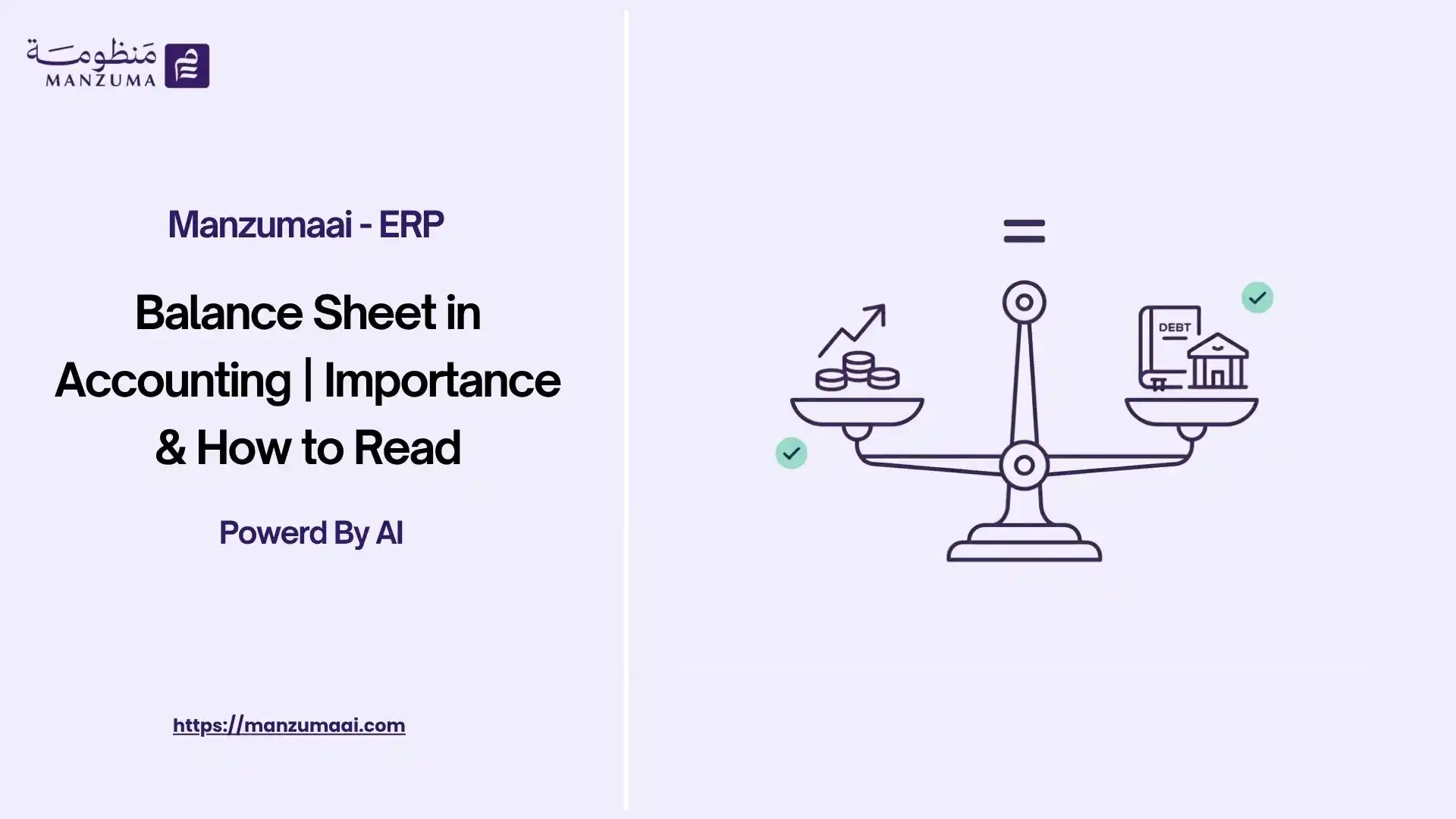
- How Does the Balance Sheet Equation Work?
- What Is the Difference Between a Balance Sheet and an Income Statement?
- How Is a Balance Sheet Prepared in Accounting?
- How Does a Balance Sheet Help Evaluate a Company’s Financial Position?
- Why Does Inventory Matter When Analyzing a Trading Company’s Balance Sheet?
- What Is the Relationship Between the Balance Sheet and Cash Flow?
- How Can an ERP System Improve Balance Sheet Accuracy?
- What Are the Common Balance Sheet Preparation and Analysis Mistakes?
A company can report strong sales and still face cash pressure So how do you know whether the business is financially healthy? The answer starts with the balance sheet in accounting This financial statement gives business owners and managers a clear snapshot of what the company owns what it owes and what belongs to its owners at a specific point in time For trading businesses it also provides valuable insight into inventory receivables payables liquidity and working capital
Why Is a Balance Sheet in Accounting Important for Every Business?
A balance sheet in accounting does more than present financial figures at the end of an accounting period It helps management understand the company’s actual financial position by showing its assets liabilities and equity in one structured view
For trading companies the balance sheet becomes even more valuable as operations grow Large inventory balances outstanding customer invoices supplier obligations multiple warehouses and short-term debt can all affect the company’s financial position A well-prepared balance sheet helps management identify these areas before they become cash-flow or operational problems
What can a balance sheet help a business evaluate?
- Overall financial position and stability
- Total assets and liabilities
- Owners’ equity
- Liquidity and working capital
- Ability to meet short-term obligations
- Financing and investment decisions
- Changes in financial position over time
Key takeaway A balance sheet does not simply tell you what the business owns It shows how those assets are financed and how financially stable the business is
What Are the Main Components of a Balance Sheet in Accounting?
A balance sheet in accounting is built around three core components assets liabilities and equity These three elements are connected through the accounting equation which must remain balanced
| Component | What It Means | Examples in Trading Businesses |
| Assets | Economic resources the business owns or controls | Cash accounts receivable inventory equipment |
| Liabilities | Amounts the business owes to other parties | Suppliers loans taxes payable |
| Equity | The owners’ residual interest in the company’s assets after liabilities | Share capital retained earnings |
In simple terms
- Assets show what the company has
- Liabilities show what the company owes
- Equity shows what remains for the owners
This relationship forms the foundation for understanding and analyzing the company’s financial position
What Are Assets on a Balance Sheet?
Assets are economic resources that a business owns or controls and expects to provide future economic benefits Depending on the nature of the business assets can include cash accounts receivable inventory equipment property investments and other resources
For trading companies current assets are particularly important because cash inventory and customer receivables are closely connected to day-to-day operations Simply looking at the total value of assets however is not enough Management also needs to understand what those assets are and how effectively they support liquidity and business operations
Professional tip A higher asset balance does not automatically mean a stronger financial position A company with large amounts of slow-moving inventory or overdue receivables may face more financial pressure than a company holding a larger proportion of liquid assets
What Is the Difference Between Current and Non-Current Assets?
The main difference is related to how quickly an asset is expected to be converted into cash sold or consumed or how long it is expected to support the business
| Current Assets | Non-Current Assets | Cash and cash equivalents |
| Property | Accounts receivable | Equipment |
| Inventory | Vehicles | Short-term investments |
| Long-term assets | Prepaid expenses | Certain long-term investments |
Key takeaway Current assets are closely tied to day-to-day operations and liquidity while non-current assets generally support the business over a longer period
What Are the Most Important Asset Accounts for Trading Companies?
Asset accounts vary from one business to another but trading companies typically rely on several accounts directly connected to the purchasing inventory sales and collection cycle
- Cash and cash equivalents Funds available in cash and bank accounts
- Accounts receivable Amounts customers owe the company from credit sales
- Inventory Goods and products available for sale
- Prepaid expenses Payments made in advance for future services or benefits
- Fixed assets Property vehicles equipment and other assets used to operate the business
- Investments and other assets Depending on the company’s activities and accounting policies
A Key Fact for Trading Businesses
Inventory is more than just a number on the balance sheet It represents capital tied up in the business until the goods are sold and the proceeds are collected
That is why inventory should be analyzed alongside sales volume inventory turnover product movement and demand
This becomes particularly important for businesses operating multiple warehouses Tracking inventory movements stock adjustments and physical counts can provide a more accurate view of the company’s assets Manzuma AI’s ERP platform supports multi-warehouse inventory management movement tracking stocktaking adjustments and integration between inventory and accounting
What Do Liabilities Mean on a Balance Sheet?
Liabilities represent the financial obligations a company owes to other parties as a result of previous transactions or events Settling these obligations generally requires the company to transfer cash or another economic resource
Common examples include accounts payable loans accrued expenses and taxes payable
Understanding liabilities is essential because the amount and timing of these obligations directly affect liquidity and financial planning Short-term liabilities deserve particular attention because they may need to be settled within the company’s normal operating cycle
Key takeaway Liabilities are a normal part of running a business The important question is whether the company has sufficient resources and cash flow to meet them when they become due
What Is the Difference Between Current and Long-Term Liabilities?
| Current Liabilities | Long-Term Liabilities |
| Accounts payable | Long-term loans |
| Accrued expenses | Long-term financing obligations |
| Taxes payable | Other obligations due over longer periods |
| Short-term loans | Long-term debt |
This classification helps management understand which obligations require near-term funding and how they compare with available current assets and liquidity
What Is Equity on a Balance Sheet?
Equity represents the owners’ residual interest in the company after liabilities have been deducted from assets
In simple terms if a company sold or accounted for all of its assets and settled all of its liabilities the remaining amount would represent the owners’ equity subject to the applicable accounting framework and entity structure
Equity may include items such as
- Share capital or owners’ capital
- Retained earnings
- Additional equity balances depending on the legal and accounting structure
- Distributions or withdrawals that affect owners’ equity
The basic relationship is
Equity = Total Assets − Total Liabilities
Equity should therefore be viewed alongside assets and liabilities rather than as an isolated figure
How Does the Balance Sheet Equation Work?
The fundamental accounting equation is
Assets = Liabilities + Equity
This equation means that every asset owned or controlled by the business is financed either through obligations to external parties or through the owners’ equity
A Simple Example
Suppose a company has
- Total assets $1000000
- Total liabilities $400000
Then
- Equity = $1000000 − $400000 = $600000
- The balance sheet equation becomes
- $1000000 = $400000 + $600000
The two sides balance
Important A mathematically balanced balance sheet does not automatically mean that every accounting entry is correct An account may be classified incorrectly while the accounting equation still balances
Key takeaway If total assets do not equal total liabilities plus equity the underlying accounts entries and adjustments need to be reviewed
What Is the Difference Between a Balance Sheet and an Income Statement?
| Comparison | Balance Sheet | Income Statement |
| What does it show? | Financial position | Financial performance |
| Time perspective | At a specific date | Over a specific period |
| Main accounts | Assets liabilities equity | Revenue expenses net income |
| Primary purpose | Shows what the company owns and owes | Shows the financial result of operations |
Both statements are essential financial reports but they answer different questions
Put simply the income statement tells you how the business performed over a period while the balance sheet shows where the business stands financially at a specific point in time
How Is a Balance Sheet Prepared in Accounting?
Preparing a balance sheet in accounting involves more than collecting numbers Accounts need to be classified reconciled adjusted and reviewed before the final financial statement is issued
Steps to Prepare a Balance Sheet
- Set the reporting date and define the relevant accounting period
- Extract account balances from the accounting system or financial records
- Identify and classify assets as current or non-current
- Identify and classify liabilities according to their nature and maturity
- Calculate equity based on the company’s approved accounting records
- Post required accounting adjustments before preparing the financial statements
- Reconcile key accounts including receivables payables inventory and bank balances
- Verify the accounting equation to ensure that the balance sheet balances
- Generate and review the statement of financial position before using it for decision-making
This process becomes more efficient when financial transactions are connected through an integrated ERP system Instead of manually transferring information between separate systems sales purchases inventory expenses and accounting data can work together within one environment According to the supplied Manzuma content the platform provides automated journal entries a trial balance more than 100 financial reports and integration between inventory and accounting
How Does a Balance Sheet Help Evaluate a Company’s Financial Position?
A balance sheet in accounting gives management a starting point for evaluating financial health However no single figure should be analyzed in isolation The strongest analysis comes from looking at several accounts together and comparing them across reporting periods
A balance sheet can help evaluate
- Liquidity Can the company meet its short-term obligations?
- Debt levels How heavily does the business rely on external financing?
- Asset base What resources are available to support operations?
- Equity What is the owners’ residual interest in the company?
- Working capital Does the company have enough current resources to support day-to-day operations?
- Solvency Is the company’s overall obligation level manageable relative to its assets and equity?
An Important Financial Insight
A company can own substantial assets and still experience cash pressure if a significant portion of those assets is tied up in slow-moving inventory or unpaid customer invoices
Key takeaway Financial strength is not determined by the size of assets alone What matters is the quality of those assets and the company’s ability to use them to support operations and meet its obligations
How Do You Read a Balance Sheet for a Trading Company?
For a trading business reading a balance sheet starts with more than total assets Management should pay close attention to cash inventory receivables payables and debt because these accounts are directly connected to the operating cycle
Does the Company Have Enough Liquidity?
Start by comparing current assets with current liabilities Then look more closely at cash receivables and inventory
However keep in mind that inventory is not the same as cash A large current asset balance does not necessarily mean the company has enough immediately available liquidity
Is Inventory Too High?
Compare inventory levels with sales volume and inventory turnover
A growing inventory balance combined with weak sales may indicate that too much working capital is tied up in products that are not moving quickly enough
Is the Company Too Dependent on Debt?
Review liabilities in relation to total assets and equity with particular attention to short-term obligations and their due dates
A high level of short-term debt can create additional liquidity pressure even when the company has substantial assets
Are Customer Receivables Taking Too Long to Collect?
A growing accounts receivable balance may mean that the company is generating sales but has not yet converted those sales into cash
Management should therefore consider receivable aging and collection performance alongside the total receivables balance
Professional tip Do not analyze a balance sheet from a single period in isolation Comparing multiple periods can reveal trends such as rising debt growing inventory or increasing receivables
Why Does Inventory Matter When Analyzing a Trading Company’s Balance Sheet?
Inventory is usually reported as a current asset but its value needs to be interpreted carefully
A trading company with $1 million in inventory is not necessarily financially stronger than a company with $600000 in inventory The more important questions are
- How quickly is the inventory selling?
- Does inventory match actual demand?
- How much working capital is tied up in stock?
Practical Example
Imagine a trading company significantly increases its inventory in anticipation of higher sales If sales fail to grow as expected a large portion of the company’s capital may remain tied up in slow-moving products
That capital could otherwise have been used to purchase high-demand products settle supplier obligations or support day-to-day operations
For this reason inventory management should not operate separately from sales purchasing and accounting The supplied Manzuma content emphasizes connecting inventory movements stock adjustments and warehouse operations with accounting
Key takeaway Inventory value matters but inventory turnover product movement and alignment with sales demand matter just as much
How Do Accounts Receivable and Accounts Payable Affect the Balance Sheet?
Customer receivables and supplier payables are central to the financial cycle of a trading company They affect both the balance sheet and the company’s ability to manage cash
| Account | Balance Sheet Classification | What It Shows |
| Accounts receivable | Asset | Money customers owe the company |
| Accounts payable | Liability | Money the company owes suppliers |
| Cash | Asset | Available liquidity |
| Inventory | Asset | Value of goods held for sale |
These accounts are closely connected through the trading cycle
Purchase → Inventory → Sale → Collection
If credit sales increase without effective collection accounts receivable may rise and place pressure on cash flow
Likewise increasing supplier balances may provide short-term financing but also create future payment obligations that management needs to plan for
Manzuma’s integrated accounting and inventory solution connects supplier account management and reconciliation with purchasing inventory and accounting
What Is the Relationship Between the Balance Sheet and Cash Flow?
A Key Financial Fact Profit Does Not Automatically Mean Cash
A business can generate strong sales and report a profit while still experiencing cash-flow pressure
Why? Because customers may not have paid their invoices yet or the company may have invested significant cash in inventory that has not been sold
The balance sheet can help management understand some of the factors behind changes in cash by monitoring
- Accounts receivable
- Inventory
- Accounts payable
- Loans and other liabilities
- Cash and bank balances
This is why financial reporting should not stop at the income statement Profitability financial position and cash flow need to be considered together when evaluating the overall health of a business The supplied Manzuma content also references financial performance reporting receivables amounts due and cash-flow forecasting
Key takeaway A profitable business can still face a cash shortage Profit liquidity and financial position tell different parts of the same financial story
How Can an ERP System Improve Balance Sheet Accuracy?
When financial data is spread across separate spreadsheets and disconnected systems preparing financial statements often requires manual data collection reconciliation and re-entry
An integrated ERP system connects operational transactions with accounting data creating a more consistent flow of information across the business
Key ERP benefits include
- Centralizing financial data
- Connecting sales with accounting
- Connecting purchasing and expenses with financial accounts
- Keeping customer and supplier balances updated
- Linking inventory movements with accounting entries
- Generating financial reports
- Reducing repetitive manual data entry
- Giving management faster access to financial information
The supplied Manzuma AI content describes an integrated environment where inventory sales invoices purchases expenses and financial reporting are connected with journal entries trial balance functionality and more than 100 financial reports
Professional tip The real value of an ERP system is not simply producing a balance sheet faster It is creating a single source of financial data so the figures in the report can be traced back to the business transactions that generated them
How Can Manzuma AI Help Trading Businesses Monitor Their Balance Sheet?
For trading and distribution companies financial data does not come from accounting alone Sales purchasing inventory warehouses customers and suppliers all contribute to the company’s financial position
That makes integration particularly important
According to the supplied content Manzuma AI provides a cloud-based ERP platform that brings accounting sales purchasing inventory warehouse management and reporting together
How does this support financial management?
- Integrated accounting Manage and track financial transactions within the same platform
- Sales and purchasing management Connect commercial transactions with financial records
- Inventory and warehouse management Monitor stock balances movements stocktaking and adjustments
- Customer and supplier accounts Track balances receivables payables and reconciliations
- Financial reporting Access financial reports and trial balance information
AI-powered analytics Manzuma’s Monjez assistant can analyze company data respond to reporting requests in Arabic or English and present some results visually
Cloud access Access business information across supported devices without relying on a single local workstation
For the trading sector specifically the supplied content highlights multi-warehouse inventory management unified sales and purchasing profitability analysis and automated bank reconciliation—functions that contribute to the quality and usability of the data management relies on when analyzing financial position
Key takeaway When accounting inventory sales purchasing customers and suppliers share the same data environment financial reporting becomes easier to connect with the actual performance of the business
What Are the Common Balance Sheet Preparation and Analysis Mistakes?
Even with accounting software data still needs to be classified reconciled and reviewed correctly
Common issues include
Failing to record necessary accounting adjustments
- Misclassifying an asset or liability
- Failing to reconcile customer and supplier balances
- Ignoring inventory adjustments
- Using outdated financial data
- Confusing profit with cash
- Failing to reconcile bank balances
- Overlooking accrued liabilities
- Not comparing current results with previous periods
Assuming that a balanced accounting equation automatically means the records are accurate
Important warning A balance sheet can balance mathematically and still contain errors For example a transaction may be posted to the wrong account while the accounting equation remains balanced
Key takeaway Accurate balance sheet reporting depends on quality data correct classification proper adjustments and financial review—not simply on making the numbers balance
When Does a Business Need an Accounting System or ERP for Balance Sheet Management?
A basic accounting system may be sufficient when a business is small and transactions are relatively simple As operations grow however manually collecting and reconciling financial data becomes increasingly difficult
Signs that a business may need an integrated ERP for business management include
- Multiple branches or warehouses
- A growing volume of daily transactions
- Large numbers of customers and suppliers
- Sales across multiple channels
- Difficulty tracking inventory in real time
- Too much time spent preparing financial reports
- Repeated data-entry errors
- The need for faster financial reporting
- Difficulty connecting sales and purchasing with accounting
- A growing need for analysis rather than simple transaction recording
For trading and distribution businesses the supplied Manzuma content highlights tools for multi-warehouse management sales and purchasing profitability analysis e-invoicing and bank reconciliation along with a 14-day free trial without a credit card
If your balance sheet depends on multiple spreadsheets manual consolidation and repeated data entry it may be time to consider an integrated ERP system
A balance sheet in accounting gives business owners a clear view of assets liabilities and equity—but its real value comes from understanding what those numbers mean For trading businesses inventory receivables payables liquidity and working capital deserve particular attention because they directly affect financial stability As operations grow an integrated ERP system can connect these areas reduce manual work improve reporting and give management a more reliable financial picture for smarter business decisions
What is a balance sheet in accounting?
A balance sheet in accounting is a financial statement that presents a company’s financial position at a specific point in time It reports the company’s assets liabilities and equity and helps management understand what the business owns what it owes and the owners’ residual interest
What are the main components of a balance sheet?
The three primary components are assets liabilities and equity These include accounts such as cash accounts receivable inventory fixed assets accounts payable loans capital and retained earnings depending on the company’s structure and accounting practices
What is the difference between assets liabilities and equity?
Assets are resources the company owns or controls Liabilities are obligations the company owes to others Equity represents the owners’ residual interest after liabilities are deducted from assets
Is a balance sheet the same as a statement of financial position?
Yes Balance sheet and statement of financial position are commonly used to refer to the financial statement that reports assets liabilities and equity at a specific date
How do you know if a balance sheet is balanced?
Total assets should equal the combined total of liabilities and equity
Assets = Liabilities + Equity
However mathematical balance alone does not prove that every transaction has been recorded or classified correctly
Is inventory included on the balance sheet?
Yes Inventory is generally reported as a current asset For trading companies it is particularly important because it represents capital invested in goods held for sale
Does profit appear on the balance sheet?
Net profit is primarily reported through the income statement but it can affect equity including retained earnings depending on the company’s legal structure and accounting treatment
How does ERP software help prepare a balance sheet?
An ERP software solution can connect sales purchasing inventory customers suppliers and accounting data reducing manual data entry and speeding up financial reporting The supplied Manzuma content states that the platform provides journal entries a trial balance more than 100 financial reports and integration between inventory and accounting
Ready to Organize Your Business?
Try Manzuma free for 14 days — no credit card, no commitment.