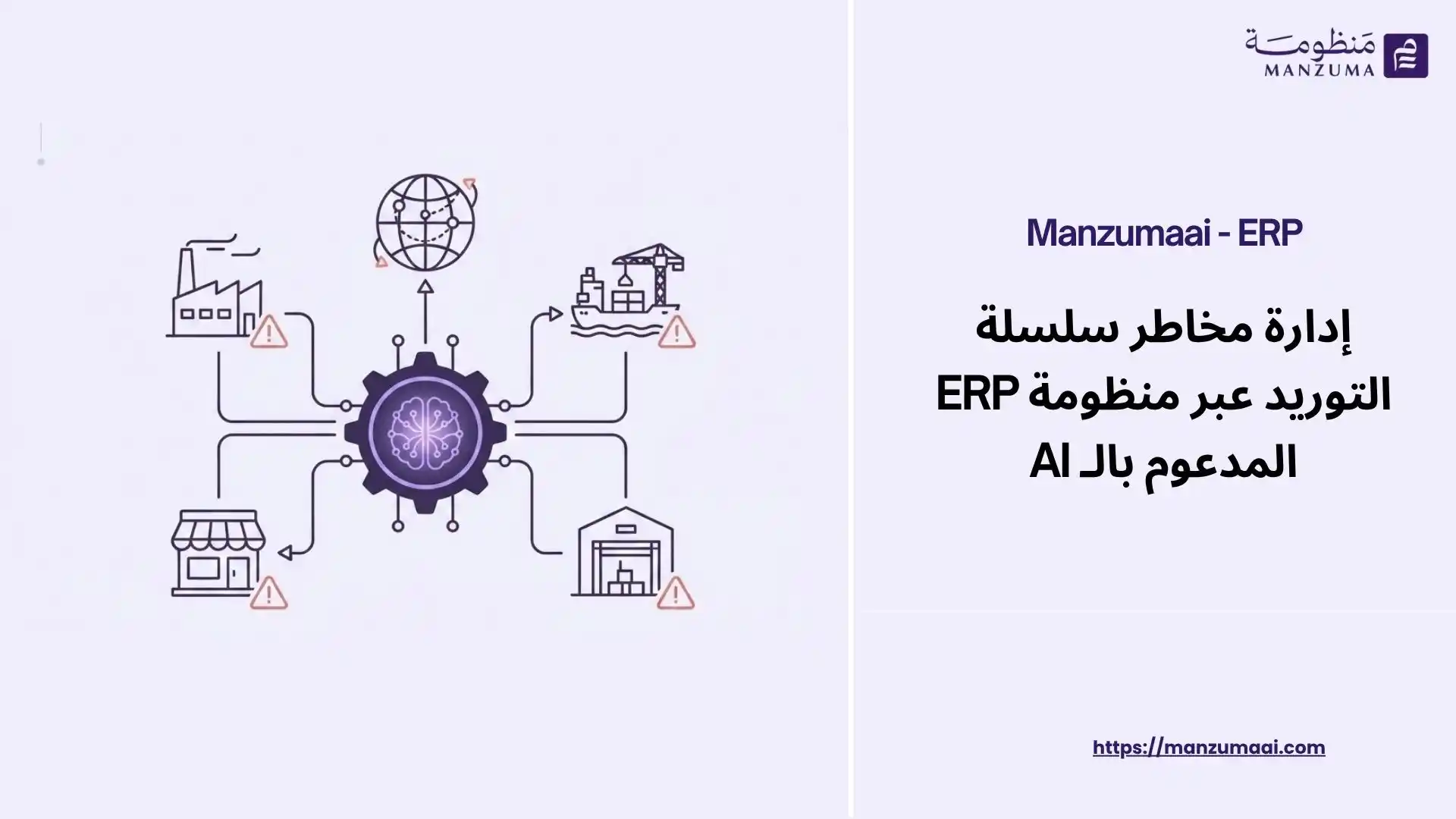
- What Is Supply Chain Risk Management?
- Why Is Supply Chain Risk Management Important for Businesses?
- Supply Chain Management vs. Supply Chain Risk Management
- Main Types of Supply Chain Risks and Their Impact on Business Operations
- Why Do Companies Struggle with Supply Chain Risk Management?
- How to Manage Supply Chain Risks Using ERP, Automation, and AI
- Steps for Effective Supply Chain Risk Management
- 3. Develop Risk Mitigation and Response Plans
- The Role of ERP in Supply Chain Risk Management
- How Automation Reduces Supply Chain Risks
- ERP, Automation, and AI: Building a Smarter Supply Chain
- Using ERP, Reports, and AI to Build a More Resilient Supply Chain
- Managing Supplier Risks Using ERP
- Managing Inventory Risks Using ERP
- Managing Procurement and Cost Risks Through ERP
- The Importance of Reports and KPIs in Supply Chain Risk Management
- Practical Examples of Reducing Supply Chain Risks with ERP and Automation
- How Manzoma ERP Helps Businesses Manage Supply Chain Risks
- Moving from Reactive to Proactive Supply Chain Management
- The Future of Supply Chain Risk Management with ERP, Automation, and AI
- Key KPIs for Measuring Supply Chain Risks
- When Does Your Business Need an ERP System for Supply Chain Risk Management?
- How to Choose the Right ERP System for Supply Chain Risk Management
- Benefits of Using ERP and Automation in Supply Chain Risk Management
- Why Choose Manzoma ERP for Supply Chain Risk Management?
- FAQs
Supply chains are no longer limited to purchasing products, storing inventory, and delivering orders. In today’s fast-changing business environment, the supply chain has become a highly connected ecosystem where a single disruption can impact procurement, inventory availability, production, delivery schedules, operational costs, and customer satisfaction.
A delayed supplier, inaccurate inventory records, unexpected shipping costs, or sudden changes in customer demand can quickly turn into serious operational challenges. This is why Supply Chain Risk Management (SCRM) has become a critical strategy for companies aiming to maintain continuity, reduce disruptions, and improve decision-making.
Successful organizations do not wait for supply chain problems to happen before taking action. Instead, they use modern technologies such as ERP systems, automation, real-time reporting, and data analytics to identify risks early, prepare alternative plans, and respond faster when disruptions occur.
In this article, we will explore the meaning of supply chain risk management, the most common supply chain risks, their causes, effective mitigation strategies, and how ERP software and automation help businesses create a more resilient and intelligent supply chain.
What Is Supply Chain Risk Management?
Supply Chain Risk Management (SCRM) is the process of identifying, assessing, monitoring, and reducing potential risks that may interrupt the flow of products, materials, information, and finances across the supply chain.
These risks may come from internal operations or external factors, including:
- Supplier delays or poor supplier performance.
- Inventory shortages or excess stock.
- Inaccurate demand forecasting.
- Transportation and shipping disruptions.
- Rising purchasing and logistics costs.
- Manual data entry errors.
- Lack of visibility across departments.
- Internal process delays and approval bottlenecks.
The main objective of supply chain risk management is not to eliminate every possible problem, which is unrealistic, but to give businesses the visibility and flexibility needed to anticipate issues, minimize their impact, and recover quickly.
A strong risk management strategy helps companies answer important questions such as:
- What happens if a key supplier fails to deliver on time?
- How can we prevent stockouts of high-demand products?
- Do we have accurate real-time inventory data?
- How should we respond to sudden increases in shipping costs?
- Are there alternative suppliers available?
- Can we detect operational problems before they affect customers?
The more clearly a company can answer these questions, the better prepared it is to maintain business continuity.
Why Is Supply Chain Risk Management Important for Businesses?
Every business that relies on suppliers, inventory, purchasing, production, transportation, or customer deliveries faces supply chain risks. Without a clear risk management strategy, small issues can quickly result in financial losses, delayed operations, and reduced customer trust.
Poor supply chain risk management can lead to:
- Delayed customer orders.
- Frequent inventory shortages.
- Excess or slow-moving inventory.
- Increased procurement and transportation costs.
- Reduced ability to meet customer demand.
- Invoice and purchase order errors.
- Lost sales opportunities due to unavailable products.
- Poor collaboration between sales, procurement, warehouse, and finance teams.
- Slow decision-making caused by inaccurate or outdated data.
For this reason, supply chain risk management is no longer optional. It is an essential part of achieving operational efficiency, cost control, and long-term business growth.
Supply Chain Management vs. Supply Chain Risk Management
Although these two concepts are closely connected, they have different objectives.
Supply Chain Management (SCM) focuses on optimizing everyday operations such as purchasing, inventory control, production planning, warehousing, transportation, sales, and order fulfillment. The goal is to ensure products reach customers efficiently, at the right time, and at the lowest possible cost.
Supply Chain Risk Management (SCRM) focuses on identifying potential disruptions that can affect these operations and creating strategies to minimize their impact.
In simple terms:
- Supply Chain Management asks: "How can we make our operations more efficient?"
- Supply Chain Risk Management asks: "What could disrupt our operations, and how can we prepare for it?"
Businesses need both approaches together. Efficient operations create productivity, while effective risk management creates resilience and long-term stability.
Main Types of Supply Chain Risks and Their Impact on Business Operations
A successful supply chain depends on smooth coordination between suppliers, inventory, purchasing, logistics, sales, and internal operations. However, any weakness in these areas can create disruptions that affect product availability, operational efficiency, profitability, and customer satisfaction.
Understanding the different types of supply chain risks is the first step toward building a proactive risk management strategy.
1. Supplier Risks
Supplier-related risks are among the most common challenges in supply chain management. Businesses often depend on suppliers for raw materials, products, or essential components, meaning any delay or quality issue can directly affect operations.
Supplier risks may include:
- Late deliveries or missed deadlines.
- Inconsistent product quality.
- Unexpected price increases.
- Supplier financial instability.
- Limited production capacity.
- Overreliance on a single supplier.
Depending on one supplier creates a higher level of risk because any disruption can impact production schedules, inventory availability, and customer orders.
Companies can reduce supplier risks by continuously monitoring supplier performance, evaluating delivery accuracy, comparing supplier reliability, and maintaining alternative supplier options.
2. Inventory Risks
Inventory is one of the most sensitive areas of the supply chain because it directly affects sales, cash flow, and customer satisfaction.
Poor inventory management can result in:
- Stock shortages that prevent businesses from fulfilling customer orders.
- Excess inventory that increases storage costs and ties up company capital.
- Inaccurate inventory records that lead to incorrect purchasing decisions.
- Slow-moving or obsolete products that reduce profitability.
Effective inventory risk management requires real-time inventory visibility, accurate stock tracking, demand analysis, and automated alerts when stock reaches critical levels.
Modern ERP systems help businesses maintain accurate inventory data, monitor stock movements, identify slow-moving items, and set reorder points to avoid stockouts.
3. Demand Forecasting Risks
Customer demand can change unexpectedly due to market trends, seasonal changes, economic conditions, or competitor activities. When demand forecasts are inaccurate, businesses may either purchase too much inventory or fail to meet customer needs.
Common demand-related risks include:
- Underestimating demand, causing product shortages.
- Overestimating demand, leading to excess inventory.
- Poor sales planning.
- Inefficient purchasing decisions.
- Increased storage and operational costs.
Using historical sales data, market insights, and AI-powered analytics helps businesses improve demand forecasting and make smarter purchasing decisions.
ERP systems provide valuable reports and real-time sales data that support better demand planning and inventory optimization.
4. Transportation and Logistics Risks
Transportation plays a major role in ensuring products move efficiently between suppliers, warehouses, and customers. Any disruption in logistics can affect delivery schedules and increase operational expenses.
Transportation risks may result from:
- Shipping delays.
- Rising transportation costs.
- Customs and regulatory issues.
- Poor delivery planning.
- Lack of shipment visibility.
- Carrier performance problems.
Businesses that monitor shipping activities, track orders in real time, and maintain clear communication with logistics providers can minimize these risks and improve customer service.
5. Cost and Pricing Risks
Supply chain costs can change rapidly due to fluctuations in raw material prices, supplier pricing, transportation expenses, and market conditions.
Without accurate cost visibility, businesses may face:
- Reduced profit margins.
- Incorrect product pricing.
- Unexpected increases in operational expenses.
- Inefficient purchasing decisions.
Integrating purchasing, inventory, finance, and accounting within an ERP system gives businesses complete visibility into actual costs, helping managers make more profitable pricing and procurement decisions.
6. Data and Technology Risks
Many companies still rely on disconnected spreadsheets, manual data entry, or separate software systems. This lack of integration often creates inaccurate information and delays decision-making.
Data-related risks include:
- Incorrect inventory quantities.
- Missing or duplicate records.
- Purchase orders that do not match invoices.
- Delayed reporting.
- Limited visibility between departments.
A centralized ERP system reduces these risks by creating a single source of accurate, real-time information across procurement, inventory, sales, finance, and operations.
7. Internal Operational Risks
Not all supply chain problems come from suppliers or external events. Many risks originate from internal processes, including inefficient workflows, human errors, and poor communication between departments.
Examples of internal operational risks include:
- Slow approval processes.
- Manual paperwork.
- Data entry mistakes.
- Lack of responsibility tracking.
- Poor coordination between sales, purchasing, inventory, and finance teams.
Workflow automation helps businesses reduce these issues by standardizing processes, accelerating approvals, sending automatic notifications, and ensuring that tasks move through the correct workflow.
Why Do Companies Struggle with Supply Chain Risk Management?
Many supply chain risks become more severe because companies lack complete visibility into their operations. Without accurate data and connected processes, businesses often react to problems only after they have already affected customers or increased costs.
The most common causes of poor supply chain risk management include:
- Dependence on manual processes and spreadsheets.
- Lack of a centralized data system.
- Inaccurate inventory reports.
- Poor supplier performance tracking.
- No automated stock shortage alerts.
- Absence of backup suppliers.
- Delayed internal approvals.
- Disconnected sales, purchasing, and accounting processes.
- Weak demand forecasting.
- Lack of clear performance indicators (KPIs).
Companies that address these weaknesses can shift from reactive problem-solving to proactive risk prevention.
How to Manage Supply Chain Risks Using ERP, Automation, and AI
Effective supply chain risk management does not happen by chance. It requires a structured approach that helps businesses identify potential threats, evaluate their impact, implement preventive strategies, and continuously improve operations based on accurate data.
Modern technologies such as ERP systems, automation, artificial intelligence (AI), and real-time analytics have transformed supply chain management from a reactive process into a proactive strategy that predicts issues before they become serious problems.
Steps for Effective Supply Chain Risk Management
1. Identify Potential Supply Chain Risks
The first step in managing supply chain risks is understanding where disruptions may occur. Every business has unique risks depending on its industry, suppliers, products, and operational model.
Companies should evaluate all areas of their supply chain, including:
- Supplier reliability and performance.
- Inventory availability and accuracy.
- Demand fluctuations.
- Procurement processes.
- Transportation and logistics.
- Product costs and profit margins.
- Internal workflows and approvals.
- Data accuracy and system integration.
Creating a complete risk map allows organizations to recognize vulnerabilities before they negatively affect business performance.
2. Assess the Impact and Probability of Each Risk
Not all risks have the same level of urgency. Some issues may cause minor delays, while others can completely interrupt production or prevent customer orders from being fulfilled.
Businesses should analyze each risk based on:
- The likelihood of occurrence.
- The financial impact.
- The effect on customers.
- The time required for recovery.
- The impact on production and operations.
For example, a delay from a supplier providing a critical raw material may represent a higher risk than a delay from a supplier providing non-essential items.
Prioritizing risks helps businesses allocate resources effectively and create targeted mitigation strategies.
3. Develop Risk Mitigation and Response Plans
Once risks are identified and prioritized, companies need clear action plans to minimize their impact.
Effective risk mitigation strategies may include:
- Maintaining alternative suppliers.
- Setting minimum inventory levels and safety stock.
- Automating reorder processes.
- Improving demand forecasting.
- Creating emergency response procedures.
- Establishing clear approval workflows.
- Regularly reviewing supplier agreements and performance.
Risk management is not about preventing every disruption. It is about ensuring the business can continue operating efficiently when disruptions occur.
4. Continuously Monitor Supply Chain Performance
Supply chains constantly change due to market conditions, customer behavior, supplier performance, and economic factors. Therefore, risk management should be an ongoing process rather than a one-time activity.
Continuous monitoring helps businesses track:
- Inventory levels.
- Supplier delivery performance.
- Purchase order status.
- Shipping delays.
- Sales trends and customer demand.
- Operational costs.
Real-time dashboards and automated reports provide immediate visibility into potential problems, allowing companies to take action before disruptions escalate.
5. Improve Supply Chain Decisions Using Data Analytics
Every supply chain issue provides valuable insights that can improve future operations. Businesses should analyze historical data to understand:
- Why a problem occurred.
- How quickly it was resolved.
- Whether it can be prevented in the future.
- Which suppliers or products create the highest risks.
- How purchasing and inventory strategies can be improved.
ERP systems provide centralized data and detailed reporting, allowing decision-makers to replace assumptions with accurate, data-driven strategies.
The Role of ERP in Supply Chain Risk Management
An Enterprise Resource Planning (ERP) system plays a critical role in reducing supply chain risks because it connects all business operations within a single platform.
Instead of managing inventory, purchasing, sales, finance, and accounting through disconnected tools or spreadsheets, ERP provides one reliable source of real-time information.
ERP helps businesses manage supply chain risks by enabling:
- Real-time inventory visibility.
- Accurate stock level tracking.
- Automatic reorder point management.
- Purchase order and invoice matching.
- Supplier performance monitoring.
- Cost tracking and profitability analysis.
- Sales and demand analysis.
- Cross-department data integration.
- Detailed reports and performance dashboards.
With accurate and connected data, businesses can detect risks earlier and make faster, more informed decisions.
How Automation Reduces Supply Chain Risks
Manual processes often cause delays, errors, and poor communication between departments. Automation removes repetitive tasks and ensures that critical actions happen at the right time.
Examples of supply chain automation include:
- Sending alerts when inventory reaches low levels.
- Automatically creating purchase requests based on reorder points.
- Routing approval requests to responsible managers.
- Updating inventory quantities after receiving goods.
- Matching invoices with purchase orders.
- Generating regular inventory and purchasing reports.
- Sending notifications about delayed orders or supplier issues.
- Tracking workflow progress automatically.
Automation allows companies to respond faster and significantly reduces the risk of human error.
ERP, Automation, and AI: Building a Smarter Supply Chain
The combination of ERP, automation, and artificial intelligence (AI) creates a more intelligent and resilient supply chain.
ERP collects and organizes business data, automation executes workflows based on predefined rules, and AI analyzes large volumes of information to identify patterns, predict risks, and support smarter decision-making.
Together, these technologies help companies:
- Forecast demand more accurately.
- Detect inventory risks before shortages occur.
- Identify supplier performance issues.
- Reduce unnecessary inventory costs.
- Improve procurement planning.
- Accelerate operational decisions.
- Enhance overall supply chain visibility.
Organizations that adopt ERP, automation, and AI move from simply reacting to supply chain disruptions to actively predicting and preventing them.
Using ERP, Reports, and AI to Build a More Resilient Supply Chain
Modern supply chains require more than manual tracking and reactive decision-making. Businesses need real-time visibility, accurate data, and intelligent tools to anticipate disruptions before they affect operations or customers.
By integrating ERP systems, automation, and AI-powered insights, companies can improve supplier management, optimize inventory, monitor performance, and make faster decisions based on reliable information.
Managing Supplier Risks Using ERP
Suppliers play a critical role in maintaining supply chain continuity. Choosing a supplier based only on price is no longer enough. Businesses must continuously evaluate supplier reliability, delivery performance, product quality, and response times.
An ERP system helps reduce supplier risks by providing complete visibility into supplier-related activities, including:
- Maintaining a centralized supplier database.
- Tracking all purchase orders and supplier transactions.
- Comparing expected delivery dates with actual delivery performance.
- Identifying suppliers with frequent delays or quality issues.
- Monitoring supplier pricing and purchasing history.
- Matching supplier invoices with purchase orders and received goods.
- Evaluating suppliers using real performance data and KPIs.
With these insights, businesses can make better supplier decisions, reduce dependency on unreliable vendors, and create a stronger supplier network.
Managing Inventory Risks Using ERP
Inventory management is one of the most important areas of supply chain risk management. Inaccurate inventory data can lead to stock shortages, excess inventory, increased storage costs, and lost sales opportunities.
ERP systems reduce inventory risks by providing accurate, real-time inventory information and automated control mechanisms.
ERP supports inventory risk management through:
- Updating inventory quantities automatically after every sales and purchasing transaction.
- Setting minimum stock levels and reorder points.
- Identifying fast-moving and slow-moving products.
- Reducing inventory counting errors.
- Connecting inventory data with sales and procurement activities.
- Tracking product movement across warehouses.
- Providing accurate inventory valuation and cost reports.
When businesses have complete inventory visibility, they can balance stock availability while avoiding unnecessary storage costs.
Managing Procurement and Cost Risks Through ERP
Unorganized procurement processes can create unnecessary expenses, purchasing delays, and poor supplier relationships. Without clear visibility into purchasing activities, businesses may buy excessive quantities, miss approval steps, or fail to control costs.
ERP improves procurement management by organizing the complete purchasing cycle, including:
- Purchase requests.
- Approval workflows.
- Purchase order creation.
- Goods receiving.
- Invoice matching.
- Financial and accounting integration.
This end-to-end visibility helps businesses control spending, improve supplier communication, and reduce procurement-related risks.
The Importance of Reports and KPIs in Supply Chain Risk Management
Effective risk management depends on the ability to identify problems before they become critical. This requires accurate reports and measurable Key Performance Indicators (KPIs) that provide a clear picture of supply chain performance.
Important supply chain reports include:
- Current inventory reports.
- Low stock and stockout risk reports.
- Slow-moving and obsolete inventory reports.
- Open purchase order reports.
- Supplier delay and performance reports.
- Inventory cost reports.
- Sales versus inventory analysis.
- Delayed customer order reports.
- Invoice mismatch reports.
- High-demand product reports.
By monitoring these reports regularly, businesses can identify weaknesses, improve planning, and take preventive actions earlier.
Practical Examples of Reducing Supply Chain Risks with ERP and Automation
Example 1: Preventing Stockouts of High-Demand Products
When a product experiences high sales volume, an ERP system can monitor inventory levels in real time and trigger automated alerts when stock approaches the minimum threshold. This gives the procurement team enough time to reorder products before shortages occur.
Example 2: Identifying Poor Supplier Performance
ERP reports can reveal suppliers who consistently deliver late or fail to meet quality standards. This allows businesses to negotiate better terms, improve supplier relationships, or select alternative suppliers.
Example 3: Reducing Excess and Slow-Moving Inventory
Inventory reports help businesses identify products with low sales activity. Managers can then reduce future purchases, create promotional campaigns, or redistribute stock to prevent unnecessary capital investment.
Example 4: Preventing Financial Errors Through Invoice Matching
By connecting purchase orders, goods receipts, and supplier invoices, ERP systems can identify differences in quantity, pricing, or received items before payments are approved.
Example 5: Accelerating Internal Approvals Through Automation
Instead of relying on manual approvals and email follow-ups, automated workflows send requests directly to responsible employees, track approval status, and reduce delays in purchasing operations.
How Manzoma ERP Helps Businesses Manage Supply Chain Risks
Managing supply chain risks requires complete visibility across inventory, procurement, sales, finance, and daily operations. Manzoma ERP provides a cloud-based platform that connects all these processes in one centralized system.
Instead of managing inventory in spreadsheets, purchasing in separate files, and financial records in different systems, Manzoma allows businesses to work with connected, real-time data.
With Manzoma ERP, companies can:
- Monitor inventory levels instantly.
- Manage purchasing workflows efficiently.
- Track supplier performance.
- Connect invoices with purchasing and accounting data.
- Generate accurate reports and dashboards.
- Automate repetitive tasks and approval processes.
- Reduce manual errors and improve operational efficiency.
With AI-powered capabilities, including the smart assistant Mongez, businesses can access information faster, analyze operational data more efficiently, and make better decisions.
Moving from Reactive to Proactive Supply Chain Management
Many companies discover supply chain problems only after customers experience delays, products become unavailable, or costs increase. A modern ERP system combined with automation and AI changes this approach.
Instead of reacting to problems, businesses can:
- Detect risks earlier.
- Receive automated alerts.
- Analyze trends and historical data.
- Improve demand forecasting.
- Make faster, data-driven decisions.
- Strengthen collaboration between departments.
A proactive approach helps companies build a flexible supply chain that can adapt to market changes and unexpected disruptions.
The Future of Supply Chain Risk Management with ERP, Automation, and AI
As supply chains become more complex and customer expectations continue to increase, businesses can no longer rely on manual processes or disconnected systems. Effective supply chain risk management requires real-time visibility, accurate data, automation, and intelligent technologies that help companies predict challenges before they impact operations.
Key KPIs for Measuring Supply Chain Risks
Monitoring the right Key Performance Indicators (KPIs) allows businesses to identify weaknesses, measure performance, and take corrective actions before small issues turn into major disruptions.
Important supply chain risk KPIs include:
- Stockout rate: Measures how often products become unavailable due to insufficient inventory.
- Inventory turnover rate: Evaluates how efficiently inventory is sold and replaced.
- Slow-moving inventory percentage: Identifies products that remain in storage for long periods.
- Supplier on-time delivery rate: Measures supplier reliability and delivery performance.
- Purchase order cycle time: Tracks the time required to complete the purchasing process.
- Inventory accuracy rate: Compares system records with actual stock quantities.
- Order fulfillment rate: Measures the company’s ability to deliver customer orders successfully.
- Average lead time: Calculates the time between placing an order and receiving goods.
- Transportation and logistics costs: Helps control shipping and delivery expenses.
- Invoice accuracy rate: Identifies discrepancies between invoices, purchase orders, and received items.
Tracking these KPIs gives management better visibility into supply chain performance and helps identify potential risks before they affect customers or profitability.
When Does Your Business Need an ERP System for Supply Chain Risk Management?
Many businesses recognize supply chain problems only after they experience inventory shortages, delayed orders, or rising operational costs. These issues often indicate the need for a centralized ERP system.
Your company may need an ERP solution if you are experiencing:
- Frequent stock shortages or excess inventory.
- Difficulty knowing the actual inventory levels.
- Delays in purchase orders and supplier communication.
- Dependence on spreadsheets for inventory management.
- Lack of visibility into supplier performance.
- Inaccurate or delayed reports.
- Disconnection between sales, inventory, procurement, and accounting.
- Repeated invoice or data-entry errors.
- Difficulty calculating product costs.
- Limited ability to forecast customer demand.
Implementing an ERP system helps transform fragmented operations into connected workflows with accurate, real-time information.
How to Choose the Right ERP System for Supply Chain Risk Management
Not all ERP systems provide the same capabilities. The right solution should help your business reduce risks, improve visibility, and automate critical processes.
When evaluating an ERP system, consider whether it provides:
- Real-time inventory management.
- Advanced procurement and supplier management.
- Automated purchase approvals and workflows.
- Integration between inventory, sales, accounting, and finance.
- Real-time dashboards and detailed reports.
- Inventory alerts and reorder point management.
- AI-powered analytics and forecasting.
- Customizable automation workflows.
- User access controls and security features.
- Cloud accessibility and scalability.
A successful ERP system should simplify operations, improve decision-making, and support business growth rather than adding unnecessary complexity.
Benefits of Using ERP and Automation in Supply Chain Risk Management
Combining ERP systems with automation gives businesses greater control over their supply chains and reduces their exposure to operational risks.
Key benefits include:
1. Reducing Supply Chain Disruptions
Real-time monitoring and early alerts allow businesses to detect issues before they interrupt operations or affect customer deliveries.
2. Improving Inventory Accuracy
Connected inventory data ensures that stock levels are continuously updated across sales, purchasing, and warehouse operations.
3. Minimizing Human Errors
Automation reduces dependence on manual data entry, spreadsheets, and repetitive administrative tasks.
4. Faster and More Accurate Decision-Making
Live dashboards, reports, and AI-powered insights provide managers with reliable information to make faster strategic decisions.
5. Lower Operational Costs
Better inventory planning, optimized purchasing decisions, and reduced waste help organizations control costs.
6. Better Supplier Management
Performance tracking and historical supplier data help companies select reliable suppliers and reduce dependency risks.
7. Higher Customer Satisfaction
Maintaining product availability and delivering orders on time improves customer trust and strengthens brand reputation.
The Future of Supply Chain Risk Management
The future of supply chain management is increasingly driven by Artificial Intelligence (AI), machine learning, predictive analytics, and automation. Companies are moving beyond simply tracking operations to predicting potential risks before they occur.
Future supply chain technologies will help businesses:
- Predict changes in customer demand more accurately.
- Identify high-risk suppliers before disruptions happen.
- Prevent inventory shortages and reduce excess stock.
- Optimize purchasing and warehouse planning.
- Automate reporting and decision-making processes.
- Improve collaboration between suppliers, warehouses, and internal departments.
- Create more resilient and agile supply chain networks.
Organizations that adopt digital transformation technologies today will be better prepared to handle future market changes and unexpected disruptions.
Why Choose Manzoma ERP for Supply Chain Risk Management?
Managing supply chain risks requires a system that provides complete visibility and control over all business operations. Manzoma ERP offers a cloud-based, AI-powered platform designed to connect inventory, procurement, sales, accounting, and reporting within a single integrated system.
With Manzoma ERP, your business can:
- Eliminate disconnected spreadsheets and manual processes.
- Gain real-time visibility into inventory and purchasing.
- Automate repetitive workflows and approvals.
- Monitor supplier performance and operational costs.
- Generate accurate reports for faster decisions.
- Reduce errors and improve overall efficiency.
Powered by AI capabilities and the smart assistant Mongez, Manzoma helps businesses access information quickly, analyze data intelligently, and transform supply chain management from a reactive process into a proactive strategy.
Conclusion
Supply chain risk management is no longer optional for companies that want to maintain operational stability, protect profitability, and meet customer expectations. Risks can arise from suppliers, inventory shortages, demand fluctuations, transportation issues, rising costs, or internal operational challenges.
By implementing an integrated ERP system with automation and AI capabilities, businesses can gain full visibility into their operations, identify risks early, reduce manual errors, and make faster, data-driven decisions.
Instead of waiting for supply chain disruptions to happen, companies should adopt a proactive approach that enables them to anticipate challenges, improve resilience, and maintain long-term growth.
Start Managing Your Supply Chain Risks with Manzoma ERP Today
Move beyond spreadsheets and disconnected systems. Transform your supply chain into a smarter, more connected, and resilient operation with Manzoma ERP.
Manage inventory, procurement, accounting, invoices, and business reports from one cloud-based platform powered by automation and AI. Start your digital transformation journey today and gain complete control over your supply chain.
FAQs
What is supply chain risk management?
Supply chain risk management is the process of identifying, assessing, and reducing potential risks that may disrupt procurement, inventory, production, transportation, or customer deliveries.
What are the most common supply chain risks?
Common risks include supplier delays, inventory shortages, inaccurate demand forecasting, transportation issues, rising costs, poor data quality, and inefficient internal processes.
How does ERP help reduce supply chain risks?
ERP reduces supply chain risks by connecting inventory, purchasing, sales, finance, and reporting in one centralized system, providing real-time visibility and more accurate decision-making.
What role does automation play in supply chain risk management?
Automation helps reduce delays and human errors by automatically sending alerts, managing approvals, updating inventory records, creating reports, and streamlining repetitive processes.
How can businesses reduce supplier risks?
Businesses can reduce supplier risks by monitoring supplier performance, evaluating delivery reliability, maintaining alternative suppliers, and analyzing historical supplier data through ERP reports.
Why is inventory visibility important in supply chain risk management?
Accurate inventory visibility helps businesses prevent stock shortages, avoid excess inventory, reduce storage costs, and improve customer satisfaction.
Is supply chain risk management important for small and medium-sized businesses?
Yes. Small and medium-sized businesses can be significantly affected by supply chain disruptions, making proactive risk management and ERP systems essential for maintaining stability and growth.
How does Manzoma ERP improve supply chain management?
Manzoma ERP centralizes inventory, procurement, accounting, invoicing, and reporting, helping businesses automate operations, reduce risks, improve efficiency, and make data-driven decisions
Ready to Organize Your Business?
Try Manzuma free for 14 days — no credit card, no commitment.